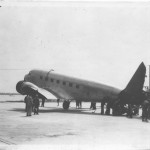
CNAC DC-2 #32, the Kweilin, was machine-gunned and forced down by five Japanese pontoon biplanes on August 24, 1938, shortly after leaving Hong Kong’s Kai Tak Airport.
Hugh Woods was at the controls, and only his hot stick flying kept the plane in the air long enough to safely ditch in a river. The Japanese seaplanes machine gunned the downed plane for more than an hour, killing two of the crew and 13 passengers. It’s the central incident of chapter 13 of China’s Wings, The Kweilin Incident, and there’s an incident report and a list of the fatalities posted at cnac.org.
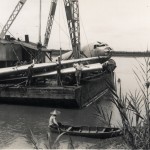
Here’s a gallery of photos of taken during the salvage operation:
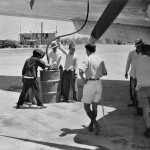
Salvaging Woody’s DC-2, shot down by the Japanese, 1938
Raising its prop
rescuing its engines
dismantling its wings
prepped for travel back to Hong Kong
raising its center section
The plane was salvaged, repaired, refurbished, rechristened and given a new number (#39, the Chungking), and in October, 1940, it became the second CNAC airliner destroyed in-service by hostile air action, at Changyi, outside Kunming. Nine people were killed in the attack, including the pilot, Foxy Kent. There would be no third shootdown for the ill-starred airplane — it burned to slag.
The DC-2 came to China in the spring of 1935, and it was a seminal moment in the development of Chinese aviation. Precursor to its much more famous successor (the DC-3), the DC-2 was a superb aircraft in its own right, faster sleeker, and more reliable than any commercial aircraft ever before seen in the Middle Kingdom. It had none of the crisscross mishmash of struts and spars that knit together previous generations of aircraft, not a single one. Something about the DC-2 inspired confidence, it looked like an airplane was supposed to look, and within 90 days of its arrival, the China National Aviation Corporation’s passenger traffic had jumped 300 percent. Through the years of writing, the DC-2 grew into my favorite airplane in China’s Wings.
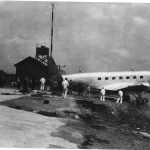
Here’s a run of photographs taken during the DC-2 arrival, all courtesy of the Edward P. Howard collection:
The DC-2 comes to China, CNAC’s first DC-2 arriving at Lunghwa Airport, 1935
As I do every year, I had a marvelous time at the just completed CNAC reunion. (If you don’t know about CNAC, the legendary China National Aviation Corporation, here’s an explanation. It’s one of the best aviation stories of all time.)
The great surprise to me was meeting Langhorne and Queta Bond. I had no idea they were coming, and I jumped out of my skin when I was introduced. Langhorne is the son of William Bond, my main character in China’s Wings, and I must say, he looks just like his old man, except bigger. Langhorne is my size, over six feet tall; I think his father was quite a bit smaller. I’d interviewed Langhorne many times, and he, Queta, and Langhorne’s brother, Thomas, were all tremendously helpful throughout the writing process. Deepening the Bond family’s aviation connections, Langhorne headed the FAA during the Carter administration.
For me, it was a huge buzz to feel how happy the CNAC family is with the book I spent so long researching and writing. It’s a nice feeling to have finally produced it, instead of always having to tell them that “I’m writing a book about CNAC.” I got as many of them as possible to sign MY copy, which now looks like a high school yearbook.
Here are a few photos of the fun:
Two of my best sources for China’s Wings sharing a laugh — Pete Goutiere and Moon Chin
Carol Slade, daughter of Chuck Sharp, another of China’s Wings most important characters, with her husband Jeff and my son, Ryan.
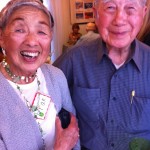
One of my weekend highlights was meeting these two — Queta and Langhorne Bond, who is the son of William Langhorne Bond, the man who carries most of the action in China’s Wings
The always delightful Francis Lee Tong, who in 1943 became CNAC’s first stewardess on the Hump.
Pete Goutiere and Moon Chin — CNAC’s two senior pilots sharing a laugh
Francis Lee Tong and Moon Chin
CNAC pilot Oliver Glenn and Keely Watson. Oliver flew Navy patrol planes against Truk during the Second World War, flew for CNAC in the post-war period, then did most of the rest of his career as an aeronautical engineer in the famous Skunk Works.
The 2012 CNAC reunion is currently running strong. Last night was the annual party at Moon Chin’s house, which was wonderful, as always.
Pete Goutiere and Moon Chin, both still going strong in their late 90s.
Pete and Moon are both among China’s Wings main supporting characters, and I’m tremendously grateful to both men. I spent many hours interviewing them. Without their wholehearted cooperation — indeed, without the wholehearted cooperation of the entire CNAC Association, I wouldn’t have been able to write the book at all.
Moon Chin has one of the most amazing lives of modern times. More than a year ago, I posted about it extensively. Here’re the links to those posts. They’re best read in order. They’re also a pretty good window into what it was like to be a Chinese immigrant to the United States in the first half of the 20th Century.
Ever wonder how much damage a 550-pound bomb did during the Second World War?
Well, last week, workers discovered one on the site of an old bar in Munich. It had a chemical fuse that couldn’t be defused, so bomb disposal experts had to set it off.
Even though the book is published and released in the world, a few lingering China’s Wings questions continue to haunt me…
The footnote in question and the 4×6 card with the information gleaned from the October 28, 1937 issue of The New York Times
I’m well aware that it’s a minute detail, but one of those lingering uncertainties can be found at the bottom of China’s Wings page 116, in a footnote in which I confess to not knowing what type of “antitoxin” Eurasia was flying from Hong Kong to Hankow on October 25, 1937. William Bond and Harold Bixby were aboard the flight, which Harold Bixby described in exquisite detail in a letter he wrote to his family on October 26, 1937. From that letter, I know that Eurasia flew the medicine free of charge, and Pan Am had flown the medicine across the Pacific the week before, also gratis, but unfortunately for the obsessive corner of my mind, Bixby didn’t specify exactly what type of medicine was aboard the plane, nor who was its intended recipient after U.S. Ambassador to China Nelson T. Johnson, and that uncertainty has nagged at me for five or six years.
Well, now I know.
Or, perhaps better said, now I think I know.
I’ve been working on a story about the 1937 Battle of Shanghai, and while scrutinizing every mention of Shanghai in The New York Times between August 1 and December 31, 1937, I hit upon the answer — or what I think is the answer.
In an article titled “Defense Improved” in the October 28, 1937 issue of The New York Times, correspondent Hallett Abend mentions that 2,000 doses of tetanus antitoxin donated by the American Red Cross and consigned to U.S. Ambassador Johnson had recently arrived in Shanghai after being flown across the Pacific on a Pan Am Clipper. Chinese gratitude for the donation was mentioned in “Chinese Thank U.S. For Medical Help,” which appeared in the newspaper three days later.
It strikes me as most likely that the drugs mentioned in those articles are the same ones that Bixby mentioned in his letter written just two days before.
The tetanus antitoxin was used to treat Chinese soldiers wounded in the Battle of Shanghai.
From the middle of the 19th Century until the outbreak of the Battle of Shanghai in 1937, the Shanghai Bund was the most prestigious, powerful, and renowned downtown city scape east of the Suez Canal, a thriving hub for the Chinese and foreign traders, industrialists, financiers, smugglers, entrepreneurs, gangsters, romantics and exiles who’d made Shanghai the most powerful city in the Orient. I fell in love with Shanghai’s municipal history during the researching and writing of China’s Wings — one of the more outstanding side effects of the project. Shanghai is a fascinating and dynamic city, and when I visited in the spring of 2005, I was surprised to discover how much of its 1920s and 30s architecture still exists.
A few weeks ago, I did a bit of writing about the Shanghai Bund for RedBANG, a European-style graphic design company working in China. So far, RedBANG has used the copy on the packaging of their “The Bund Shanghai” microfiber lens cloth promotional product and in the About section of The Bund Shanghai’s Facebook page (where they’ve been posting some spectacular old and new photos).
That made me think I should post all the old China’s Wings and CNAC photos I’ve collected that show the Shanghai Bund into one photo gallery. All of these photos come courtesy of the Edward P. Howard collection:
CNAC’s first Douglas Dolphin over Shanghai, October 1934
Maiden flight over Shanghai, 1935
Maiden flight of CNAC’s first Douglas Dolphin over Garden Bridge and Broadway Mansions, October 1934
Maiden flight over the Shanghai Bund, 1935
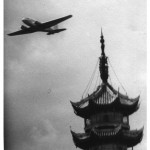
CNAC’s first DC-2 over the Shanghai Bund on her maiden flight, 1935
Not technically the Bund, but close: the Shanghai Post Office with CNAC sign on its clock tower, middle 1930s
An email dropped in from a climbing friend of mine this week that leaves me honored, haunted, and humbled. And stunned.
The email tells the story of a friend of his in a tough spot, stricken with cancer that isn’t responding to chemo. His bone marrow transplant didn’t work. He’s 21 years old. He read Enduring Patagonia and loved one of its passages so much that he chose to hang it above his hospital bed:
“The night is jet black. Only the periphery of my vision can discern the edges of the great peaks against the inky sky. I trace out the shapes in the dark, and the massive bulks of stone and ice seem to stand in the coal-black night like a vast heavenly tribunal, hunkered down against time and divided from me by an impenetrable void. We are here, proud and alone, but of all the tortures meted out to man, this is the hardest to bear: that the universe doesn’t care. The universe is utterly unmoved by the human condition, and a god’s wrath would be a much easier burden than the eternal indifference apparent in this black night.”
That man has true courage. Maybe this writing thing actually is worth it.
As C.S. Lewis said, “We read to know we are not alone.”