China’s Wings excerpt


An email this morning from Tracy Devine, my delightful and talented editor at Bantam,  brought to my attention a China’s Wings excerpt posted by Powell’s Books. Here it is, Saint Patrick’s Day, 1931, which is Chapter One, in its entirety. It’s also here, on the Random House website, where the format is a little cleaner.

And allow me to tip my hat to Powell’s Books. It’s my favorite outing in Portland, Oregon, a veritable cathedral of civilization.

Share

Huge news from Patagonia!


The Torres at sunrise

Breaking news from Patagonia, reported by Colin Haley, is that Hayden Kennedy and Jason Kruk have completed the first “fair means” ascent of Cerro Torre’s SE Ridge (the left-hand skyline in the photo), not using any of Maestri’s infamous bolts for progress or security. People have been trying to accomplish this feat for DECADES, so it’s a tremendously significant ascent.

Here’s the newsrelease at Alpinist, and here’s what Colin Haley posted on Facebook:

“BIG NEWS: Although Jorge and I unfortunately fluffed this weather window, today we got to watch history being made through a Canon G12 zoom lens at Norwegos: Hayden Kennedy and Jason Kruk made the first fair-means ascent of the SE Ridge of Cerro Torre. Although I’m not 100% sure about the details, I think they took about 13 hours to the summit from a bivy at the shoulder, which is amazingly fast considering the terrain. The speed with which they navigated virgin ground on the upper headwall is certainly testament to Hayden’s great skills on rock. Bravo! They might be in the mountains several more days (more good weather coming), but I’m sure we’ll hear the details soon!”

Huge congratulations to Hayden and Jason. I’d guess that these days in Patagonia are going to color the rest of their lives, similar to how my adventures in the extreme south have governed mine. I haven’t gone hard down there in more than a decade, since I finished Enduring Patagonia, but Charlie Fowler, with whom I once watched the sunrise from the summit of Cerro Torre, provided the first glimmer of a clue that set me on the trail of China’s Wings — the project that has governed most of my last decade. Here’s the story of how he did it, and how it played out.

(As a parent and a climber, I’d also love to chat about this with Michael and Julie Kennedy.)

Share

CNAC and the Flying Tigers


AVG & CNAC joint reunion booklet cover, 1962

CNAC and the Flying Tigers… and that’s the American Volunteer Group, the real Flying Tigers,  not just any old US Army Air Corps pilot who served in China during World War II.

(Ask any member of the AVG — they’ll set you straight, and right quick).

CNAC was desperately short of pilots in the summer of 1942, just as it was expanding operations to prove that an airlift over the eastern Himalayas, the daunting “Hump,” was possible. When Claire Chennault’s AVG disbanded on July 4, 1942, 16 AVG pilots signed on with CNAC and flew the Hump for the remainder of the war.

For years after the war, the two organizations conducted joint annual reunions at the Ojai Valley Inn in Ojai, California… and if the stories are to be believed, they were outrageous bacchanalias.

Posted above is the cover of their 1962 reunion booklet.

Next, I’ll explain why you’re connecting to CNAC & the Hump every time you send a package via Fedex…

Share

CNAC wreckage found in Western China


photo courtesy of Jim Dalby and cnac.org

Bob Willett, CNAC association member and author of An Airline at War: The Story of the China National Aviation Corporation and Its Men, and Clayton Kuhles of MIArecoveries.org, recently discovered the wreckage of the first CNAC airplane lost on the Hump — CNAC #60, a C-47 that went missing over  western China on November 17, 1942.

Willett’s cousin, James Brown, was copiloting CNAC #60 the day it went down.

Here are Willet and Kuhles featured in a brief  MSNBC.com news spot.

Share

Some of my best friends, and some more on Barbara Tuchman


Building on what I said yesterday about how Barbara Tuchman’s book Practicing History helped me organize my research, through the years, I’ve read most of the major works in Barbara Tuchman’s canon: The Guns of August, The Proud Tower, A Distant Mirror (in a Patagonian basecamp), and, of course, Stilwell and the American Experience in China. If my count is accurate, I’ve read Stilwell 4 times, once for a military history course on the China-Burma-India theater while I was a cadet at West Point, once before I wrote the China’s Wings book proposal, a third time while I was writing it, and a fourth (and probably final time) after I finished my first complete draft. There are a few places where I find I don’t agree with her analysis, most notably around the massive Battle of Shanghai fought in the last half of 1937, but in the main, I think she’s spot on.

Some of my close friends… Dalleck on the right all the way to the official histories on the left (through Slim, Allen, Bayly & Harper, Tuchman, Sherwood, Speer, Shirer, Stimson, Morgantheau, the State Department, Morrison, Marshall, and Churchill). That’s about a fifth of the books assembled for China’s Wings.

For the record, Tuchman’s Stilwell isn’t the only book that received such massive attention during my writing. I cover-to-covered Charles F. Romanus’s and Riley Sunderland’s magisterial three-volume history of the CBI at least a half a dozen times. It was on my desk constantly through the writing of China’s Wings Part IV. For the first sections of the book I was constantly checking facts and events in letters against Robert Dalleck’s Franklin Delano Roosevelt and American Foreign Policy, 1932-1945, Jonathan Spence’s Search for Modern China, and David M. Kennedy’s Freedom from Fear: The American People in Depression and War, 1929-1945.) All three of which are superb books.

I’m excited, humbled, and more than a little trepidacious as I attempt to stand alongside such great books.

Share

Practicing History, or, How Barbara Tuchman saved my bacon


Barbara Tuchman is one of the best writers of history. She’s wonderful storyteller, I strongly recommend any of her books, and although she died in 1989 and I never had the opportunity to meet her, but her book Practicing History seriously saved my bacon.

I threw myself into the research as soon as I sold the China’s Wings proposal, reading and taking notes as widely as I could, and I quickly amassed a large quantity of material. Using a process I’d used to great effect prior to working on China’s Wings, I stored every note in a file I titled “China’s Wings: Raw Ideas,” but that file quickly grew to hundreds of pages and thousands of bullets — way to large for my head to embrace, and without any practical means of sorting or grouping material. Progress ground to a halt as I groped for a way to gain control of my research that would allow me to both understand what I had and allow me to more forward.

I was saved, quite by accident, when I happened to read Barbara Tuchman’s Practicing History. It’s one of her few obscure books, published in 1981, but in one of its chapters she described her method of organizing research on index cards and I instantly recognized the utility of her system.

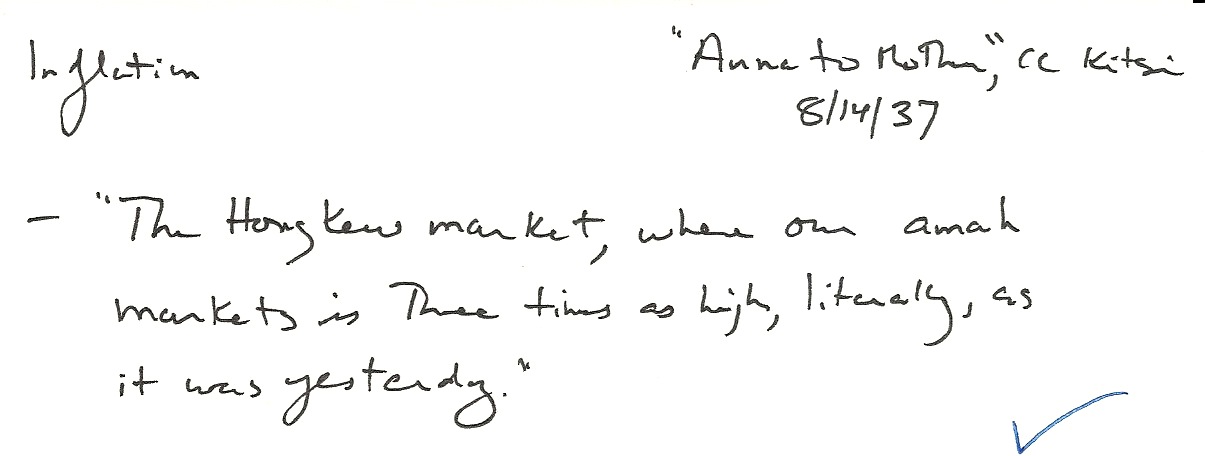
Subject went in the upper left corner of the card, source went in the upper right, and the factoid, quote, observation, or line went in the middle of the card. It proved the perfect system for managing my research, and my office and bedroom were soon a blizzard of 4×6 cards. I’d gather related cards into stacks several inches thick, pin them in binder clips, and from the stacks grew my chapters. As a bonus, the card stacks proved easily portable, so once I had assembled the research for a chapter, I could cart it off to a library, cafe, or bar to work. All of which helped.

Here’s the “August 1937 to source and use” card stack that became Chapter 8, “Things Fall Apart”, about CNAC caught astride the outbreak of the Sino-Japanese War. The cards at the bottom whose top edges are marked in blue are the research morsels  that I ended up using in the story. The unmarked ones on top are the tidbits that never found a home. They’re about equal in volume.

Here are a few of the cards themselves. This one is from Emily “Mickey” Hahn’s China to Me. And since my writing is next to indecipherable, sometimes even to me, that says, “Watching the war from rooftops, drinking cocktails.”  (I count myself the latest in the long line of men to fall in love with Mickey Hahn. And NOTE: I’ve posted about Mickey more recently, adding an anecdote that was the hardest cut from the draft of China’s Wings.)

This one is sourced from the New York Times, describing the fighting on August 14. The bullet points describe intense shelling, ground combat all day; Japanese naval gunfire; ferocious hand to hand combat; Idzumo attacked again; field guns, mortars and naval gunfire support; 8,000 Japanese v. 30,000 Chinese; Japanese stripping the crews of their warships to bolster their marine units ashore.

Percy Finch’s book Shanghai and Beyond provided the data on this card, which was used (along with MANY others) to help describe the “Black Saturday” bombing at the corner of Nanking Road and the Bund. (Shanghai and Beyond is a good book, albeit an obscure one.)

Here are described the actions of CNAC pilot Frank Havelick, taken from a letter to Andre Priester, the text of which was provided to me by Nancy Allison Wright. The DC-2 on this card became the “Hong Kong DC-2”, a massive bone of contention between Pan Am and CNAC’s Chinese leadership in August, September, and October of 1937.

This information about inflation in Shanghai caused by the outbreak of war comes from a letter “Anna to Mother, CC Kitsi [Bond]”, 8/14/1937, in the William Langhorne Bond collection at the Hoover Institute Archive.

The line “food prices tripled” in the center of the page photographed below is the line created from the “Anna to Mother, CC Kitsi” card, and I confirmed the fact in one of my interviews with Moon Chin.

And here to the right we have a conversation from an interview conducted with Harold Bixby that found its way into the Pan Am Archive at the University of Miami. That’s Bixby and TV Soong arguing about the militarization of CNAC by the Chinese Air Force.

Those factoids — from books, newspapers, letters, and interviews — are among the many dozens that went into the creation of pages 93 to 97.

And that was how the sausage got made, bit by painful bit.

Here’s a link to “A Heroine of Popular History,” an excellent article about Barbara Tuchman and Practicing History by Bruce Cole that appeared in The Wall Street Journal on March 10, 2012.


Share

China’s Wings now available for pre-order


I think it’ll only be another few weeks before I get my advance copies of China’s Wings. My guess is that I’ll have them in the last week of January.

And I’m happy to announce that China’s Wings is available for pre-order at Amazon and Barnes & Noble.

Also, I’ve put up a Facebook page for China’s Wings, and I’m hoping you’ll pop over and give it a “like” and help spread the word amongst your friends.

Share

Exciting first ascents completed in Patagonia this season


In retrospect, probably the best day of climbing I’ve ever had — first ascent of Aguja Poincenot’s north face, 1996

I’ve got Patagonia on the brain having given Enduring Patagonia’s Winter West Face slide show to the Rock, Ice, Mountain Club in Santa Rosa last night, and this morning, I’m seeing reports from several exciting new routes recently completed in the Fitzroy/Cerro Torre massif — my favorite mountain range on earth. I spent a significant portion of the 1990s in those mountains. Without doubt, those are some of the best times I’ve ever had, even if they sometimes feel like they happened to someone else.

I’d forgotten how much fun giving a slide show can be. The club turned out a good crowd, and they seemed excited and inspired with the vision of Patagonia — as was I. The energy was contagious, and I had a hard time winding down after I got home. Met a lot of great people, too. I tacked a dozen photos from China’s Wings (which is available for preorder) on to the end of the show and was happy to sense the enthusiasm with which they were received.

Jim Johnson’s mother, Blanche Christina Tenney, in Shanghai in 1938, courtesy of Jim Johnson

Jim Johnson was one of the climbers who turned out last night. Turns out his mother did a bunch of her growing up in Shanghai during the 1930s. I love that sort of coincidence, and Jim just guided me to Tess in Shanghai, the website of Tess Johnson, a writer who has written extensively on the great city of Shanghai.

But back to the climbing, here are links to the new routes completed thus far this season in Patagonia. Doesn’t look like the range is even close to climbed out yet, and I’m glad to see people finding the same quality of adventure I enjoyed down south in that other lifetime.

First, there’s a new route completed on the SW face of Aguja Poincenot by Jens Holsten, Joel Kauffman, and Mickey Schaefer… lots of good photos and accompanying story on Kauffman’s blog… The route is on the opposite side of the mountain from the Old Smuggler’s Route, which Jim Donini and I did on Poincenot’s North Face in the photo above.

Hayden Kennedy and Jason Kruk knocked out The Gentlmen’s Club on Aguja de la S, describing the line as “Royal Arches to Astroman,” two of Yosemite’s better routes, one easy, one hard. With a hell of a lot better view, I might add.

Third comes a super-impressive looking new line on Torre Egger, one of the “Seven Real Summits,” as it’s likely the hardest mountain to climb in South America, and probably entire the Western Hemisphere. Completed in a two-day push by Norwegians Bjorn Eivind Ortun and Ole Lied, it looks absolutely spectacular — and totally desperate. Here’s a brief summary posted by Rolando Garibotti on Pataclimb.com, by far the world’s best source for Patagonian climbing information.

Way to go, guys! Heartfelt congratulations.

Share