Powerlines Productions video of the single best swell I have personally witnessed in 33 years of surfing.
This season can’t get started soon enough.


Powerlines Productions video of the single best swell I have personally witnessed in 33 years of surfing.
This season can’t get started soon enough.
 Building on the “Fleeing Shanghai” series of China’s Wings outtakes I’ve been posting, which detail what happened to the China National Aviation Corporation (CNAC) and its people at the outbreak of the Battle of Shanghai in mid-August 1937. This one adds to the “Tensions in the partnership” episode I added last week. This probably took place on 18 or 19 August, 1937:
Moon Chin found himself alone at the Hankow airfield. The Caucasian pilots had vanished. Moon ran across Joe Chen, one of the Stinson copilots, and Joe Chen was equally confused. Two of CNAC’s four DC-2s sat idle on the airstrip, along with two Stinsons and Donald Wong’s “Tin Goose” Ford. No one in operations knew where the other pilots had gone. Havelick had taken the third DC-2 to Canton on Bixby’s orders. Moon Chin suspected Havelick had a planeload of Americans on board.
Moon Chin wasn’t checked out to captain a DC-2, but he’d been copilot on CNAC’s first DC-2 crew, and he’d flown several hundred hours in the plane. The Japanese would swarm to attack if they discovered the DC-2s, and on the ground, they’d be easy targets. Moon Chin had never flown one alone, but who was going to examine his credentials and grant permissions in such times? Moon climbed into the cockpit of the newest one, spooled up the engines, and took off, racing east for Chungking, safe beyond the Yangtze Gorges.

Joe Chen followed Moon Chin’s example. Stinsons were expendable; DC-2s were not. Joe Chen had done copilot time in the DC-2, but not much, and he hadn’t checked out as captain in any airplane – he’d failed his most recent check ride. Chen got the big transport running, and moving, but just as he lifted off the airfield one of his wheels smacked against a Socony fuel trailer. Chen got the sturdy Douglas into the air despite the hefty bump, and he prepared to follow Moon Chin westward, but he had second thoughts. He thought he’d damaged the undercarriage, and the airline had repair facilities in Hankow and none in Chungking. Chen circled back. He lined up an approach and began his descent. He put the fuel mixture controls in the TAKE OFF AND CLIMB position, set the carburetor air controls to COLD, and checked the magnetos and hydraulic pressure. Chen reduced speed, lowered the flaps, and advanced the propeller pitch. Chen concentrated on the airfield and eased down the glide slope. He cut his speed to under a hundred miles per hour and bled off the last few hundred feet of altitude. It was a perfect approach. Chen flared to land, kept the nose up, and eased the plane onto the field. There was a horrible pause, devoid of the bump and kiss of a happy landing. Chen had forgotten to lower the undercarriage. The 14,729-pound[1] airplane fell the last twelve feet to the runway. The props struck first, ripped from their shafts, and windmilled past the cockpit. A wing snapped off outboard of the engine. The aluminum underside peeled open and dredged a furrow down the runway. Both engine nacelles broke off and bumped under the wing. The plane swerved to a stop. The propellers leapt across the field, slowing and wobbling and toppling into the weeds beside the runway. The plane was wrecked, but it didn’t burn. Chen was unharmed.
Moon Chin winged up the Yangtze Gorges in the other DC-2. A thirty-foot head of midsummer floodwater submerged CNAC’s sandbar airstrip in the river below Chungking. Moon landed at the military airstrip twelve miles east of the city.
* * *
Sources for this anecdote: author’s interviews with Moon Chin, September 17, 2004, January 7, 2005, April 19, 2006; Bixby to Morgan, August 25, 1937, written aboard the S.S. President Pierce en route to Hong Kong; Bond to Kitsi, written in Hong Kong, August 28, 1937; both letters in the Bond Papers.
Next in this series is “Moon Chin’s wife cheats death escaping Shanghai”
[1] The DC-2’s empty weight. Chen’s plane would have weighed more considering the fuel aboard.
So, on Wednesday, I posted my “Only in America: “Get a gun and the dog!”” piece at 7:15 a.m., and in it, I tried to milk a little extra humor from the post with a snarky aside that raised an eyebrow over whether a Tennessee woman would really be coming home from a gym at 3 a.m. Six hours later, I got an email from Melissa Twiner, the unfortunate woman who’d been chased home by the off-duty policeman as she was returning from the gym, and she was not happy with me. “As unbelievable as that may seem it is true,” she wrote. “I admit this story is bizarre but I cannot sit back and basically be called a slut or junkie, or whatever you were thinking.”
That brought me up short. I’d made the quip hoping to get a laugh, but upon rereading, I could see where Melissa would have jumped to that conclusion. I apologized as fast as I could type and adjusted the post to reflect her input. And I felt pretty awful for trying to milk a laugh from a story when—of course—there was a real human being on the other end, and as we emailed back and forth it became apparent how upset she was to suddenly find herself a central player in a viral internet shit storm. And I hadn’t helped.

By the end of the day, we’d become Facebook friends, which afforded me a glimpse into what seems to be a very good-hearted and successful American life, and for the next day, I couldn’t stop thinking about Melissa and Brett Twiner. The more I thought about them, the more convinced I became that they’d both behaved well in a very volatile situation. I decided to investigate a little more deeply, and Melissa agreed to let me interview her. Which I just did.
And let me just say, Melissa Twiner sounds like a sweet as apple pie southern girl, with a lovely Tennessee drawl. Her husband Brett is an Army veteran, owner of a successful metals refining business, and Melissa works hard for the business, doing long-haul pick ups and drop offs from their headquarters in Soddy-Daisy. They’ve been married five years, and last weekend’s altercation shattered their quiet anonymity when it become internet fodder for forums of hunters, 4×4 builders, gun enthusiasts, and the like.
Melissa repeated some of the worst comments to me, and they’re absolutely appalling.
“I can’t imagine why anyone in the world would want to be a celebrity or a politician,” she said.
According to Melissa, Brett can be pretty intimidating. “He’s a big bald guy with big broad shoulders and a Fu Manchu mustache.” Brett’s also an AA class competitive shooter who had a .45 caliber pistol in his hand that night. “He was the calmest person out there,” Melissa explained. “I think it bothered him more that people on the internet said he was aiming and that he missed.”

Things seemed to be more or less under control until the two drunk sisters got out of the off-duty cop’s Toyota. They later said the got out of the truck to pet the Twiner’s dog—a 190-pound South African mastiff named Tiberius—but they almost immediately started insulting Melissa, calling her two names no woman should ever have to hear, certainly not in her own driveway at three o’clock in the morning.
Even though she faced two opponents, Melissa didn’t hesitate to defend her honor. Brett fired the second warning shot when it looked like one of the two sisters was about to haul off and kick his wife.
It took a few more seconds, but Brett’s warning shot defused the situation, and as reality set in, the off-duty policeman began apologizing. As well he should.
“He seemed very sincere, and that’s why we decided not to do anything more about it,” Melissa said. “Those girls probably amped him up. I drive a car with neon lights on it. It’s a nicer car, I work hard for it, and there’s a lot of bumps in the road on the way up the mountain which probably made it look like I was flashing my brights.
“Funny, but if I’d been driving my F150, probably none of this would have happened. They’d have thought I was some big old guy with a gun in my truck instead of an itty-bitty white chick in a nice car.”
Personally, I think both Melissa and Brett Twiner deserve commendation. In the heat of the moment, Brett Twiner seems to have done exactly the right things to prevent a bad situation getting worse. A lot worse. He should feel great about how he defended his wife and put the situation to rest as best he could. I can’t think of anything he could have done better. And amidst all this mess, I hope Melissa’s feeling pretty great about that, too–I think she is. And then the Twiners showed compassion by not pushing back against the off-duty policeman, which could well have cost the guy his job.
The one member of the Twiner family who didn’t comport himself admirably is their dog, Tiberius, the 190-pound South African mastiff. “Ty was totally useless through the whole incident,” Melissa laughed. “He done nothing, ‘cept look. He let everybody pet him. Let’s just say that I felt a little indifferent to him through about the next three days.”

Melissa sounds like quite an animal lover, and she also keeps horses. “I grew up poor, and I always said when I was grown up I’d work hard enough to make enough money to have my own horse, but they’re like potato chips. You have one and you want another, then another, and now I have four.”
She’s training them as therapy horses so she can give rides to children suffering from autism and cerebral palsy.
Only in America, indeed.
I’m grateful for the lesson in humility I just received at the hands of Mrs. Melissa Twiner.
By the time the Caucasian personnel of the China National Aviation Corporation (CNAC) returned to work after tending to the evacuation of their families, recounted here, the airline was in bad shape–tensions in the Sino-American partnership, the strength of which had always been an organizational pillar, threatened to tear the company apart.
Those tensions were about to get much worse:

Many of CNAC’s pilots were in Hankow, awaiting instructions. Harold Bixby met with those still in Shanghai, trying to decide how to manage the deteriorating situation. China needed CNAC’s Caucasian pilots and mechanics, and with China becoming daily more embroiled in the colossal battle developing with the Japanese in Shanghai, Company Managing Director Colonel Lam Whi-shing felt his country had a right to expect them to help. Bixby already knew they couldn’t: the American personnel had State Department instructions to stop flying, but CNAC owed Pan Am about $60,000 U.S. dollars for transpacific sales CNAC had agented. Bixby tried to pry the sum loose from Colonel Lam, but Lam wouldn’t pay without an American promise to continue helping. Bixby tried to force CNAC to pay Pan Am’s debt by refusing to co-sign the CNAC checks needed to finance what Colonel Lam felt were the company’s urgent and legitimate operational needs – to get the company’s Chinese staff evacuated to Hankow and to keep the airplanes flying in support of the rapidly widening war. Colonel Lam borrowed $300,000 (mex.) from the Ministry of Communications in CNAC’s name, kept the money in cash, and used it to finance the flying.

Pilot Frank Havelick had one of the DC-2s in Hankow on August 18. Bixby ordered him to fuel the airplane, collect Royal Leonard, Floyd Nelson, Hugh Woods, and any other Americans he could find and fly the plane to Canton. Bixby’s public message asked Havelick to deliver the plane to the Chinese Air Force. There were probably other private communications. As Havelick approached Canton, CNAC’s agent there radioed Havelick the news that the local weather was so bad that he should divert to another airfield. The Canton weather was fine, but Havelick received the subtext: Bixby wanted him to divert to Hong Kong. He did. The $60,000 U.S. dollars CNAC owed Pan Am just about exactly matched the value of a used DC-2. Bixby and Allison sent a radio message on the CNAC network ordering Havelick to return to Hankow, but Bixby used Pan Am’s private code to radio a message to the company’s Hong Kong agent telling Havelick to stay in Hong Kong until released by Bixby’s private signal. The first part of the plan worked: Havelick stayed. But the station manager at Kai Tak airfield, a British officer named Lieutenant A.R.J. Moss, got word of the scheme, and he wanted no part of a conspiracy that might foul the colony’s relationship with Nationalist China.
Moss radioed to all stations that Havelick was staying in Hong Kong pending receipt of Bixby’s confidential orders. CNAC’s Chinese leadership monitored Moss’s message, and Bixby’s blatant “horse-stealing” shredded any vestige of good will that remained between the Chinese and American partners.
(ASIDE: Lt. Moss features in another one of my China’s Wings outtakes posts from more than a year ago: Emily Hahn and CNAC, aka the hardest cut, part III, which is hilarious.)
The Chinese were pulling CNAC in one direction, the Americans were pulling it in another, and the tension tore their partnership apart. Havelick hadn’t taken out all the American personnel. Some remained in Shanghai. Tremendous chaos beset the remaining personnel. Nobody had slept because of the booming guns. Overwrought pilots bickered with strung-out managers. “Orders” came to CNAC from the Ministry of War, the Ministry of Communications, and the Aviation Commission, and Colonel Lam kept promising DC-2s to every official in China. Colonel Lam gave confused, nonsensical orders that would have kept the pilots in the air twelve hours a day, and he treated them like he would have dealt with an air force squadron. Allison and Bixby countermanded the most egregious instructions. The American pilots felt like they were being press-ganged into the Chinese Air Force. Allison was under a tremendous strain, consumed with worry about his pregnant wife. A kind and gentle man at home, he was always stern with his pilots, and he was staunchly pro-Chinese. Allie drove his pilots. They balked and refused orders. “Allie was typical”: he tried to do it all himself. He flew a Dolphin from Lunghwa to Minghong, hid it in a creek, had himself driven back to Lunghwa, and then flew another one of the company’s hydroplanes to another hiding spot. Allie accused the pilots of malingering. “Everybody had a tremendous row.”

Bixby told Lam that the only way the Americans could continue was if the Americans had complete control. Lam had to stop making promises without consulting the Americans. Contractually, operations was the purview of CNAC’s American partners. Ernie Allison was operations manager. He should be the one deploying the airplanes. In his search for solutions, Bixby proposed dividing the airline. One part would comprise Chinese personnel able to conduct military support missions, the other would be the Americans restricted to commercial undertakings. Colonel Lam wouldn’t hear of it. American pilots were the only ones checked out to fly the DC-2s. Bixby’s proposal denied him use of the best transport planes in Asia. Colonel Lam stood to lose much face if he were unable to command them. Lam tried to get Bixby to compromise. CNAC was a Chinese-owned company. It had bought those four DC-2s with Chinese money earned in China. Those airplanes were Chinese property. An ardent patriot, he thought the Americans had been intentionally slow in checking out Chinese DC-2 captains they could keep control of the company’s most valuable assets. Moon Chin, Donald Wong, and Joy Thom were clearly capable of handling the airplane.
* * *
Colonel Lam’s loan; meeting with Colonel Lam: Bixby to Morgan, August 25, 1937, written aboard the S.S. President Pierce en route to Hong Kong, the Bond Papers.
Havelick’s DC-2 flight to Hong Kong, and the complications of its return: Nancy Allison Wright’s interview of Frank Havelick, April 17, 1991, text provided to the author via email on November 27, 2005; Bixby to Morgan, August 25, 1937, written aboard the S.S. President Pierce en route to Hong Kong (“Horse stealing” is the phrase Bixby himself used in the letter); Havelick to Andre Priester, December 9, 1937; both letters in the Bond Papers.
Conditions in Shanghai; bickering between the airline personnel; “Allie was typical”; Allison trying to do it all himself and his efforts to save the planes; “Everybody had a tremendous row”: Bond to Kitsi, written in Hong Kong, August 28, 1937, the Bond Papers; author’s interview with Moon Chin, January 7, 2005.
Colonel Lam’s sentiments about the Americans being slow to check-out Chinese DC-2 pilots: author’s interview with Moon Chin, April 19, 2006.
Today’s “only in America” story starts in the wee hours of Saturday morning, August 3, 2013, at the end of a birthday celebration that closed Charlie’s Lounge, an establishment in the town of Soddy-Daisy in the great state of Tennessee. (And thanks to Rob Robinson for turning me on to this gem.)

 If I’ve fished out the correct drinkery, this 17-second video locates the beginning of the adventure…
Sometime before 3 a.m., an off-duty policeman left Charlie’s with two sisters.
An on-duty policeman would later determine that although the off-duty officer had been drinking, he was not “too intoxicated to drive.”
One of the two sisters would prove “too drunk to give a statement.”
If I’m correctly interpreting the incident report published by The Chattanoogan.com (which ain’t easy), the off-duty police officer was driving his Toyota pickup down a road. Coming up the road behind them was a woman named Melissa who said she was driving home from the gym. At 3 a.m.
(EDIT: As unlikely as that sounds, considering the Tennessee women I’ve known, I received an email from Melissa shortly after I published this saying that she got home from a business trip at 11 p.m. that night–a 500-mile road trip–unwound bit with her husband, then went to the gym at 1:30 Saturday morning and was indeed coming home from the gym at 3 a.m.)
Anyway, Melissa drove up close behind the off-duty officer, who pulled to the side to let Melissa pass, then pulled back onto the road and began tailgating Melissa. Showing her annoyance, Melissa apparently “brake checked” the Toyota pickup repeatedly.
Melissa turned off the main road toward her house.
Enraged, the off-duty officer followed her.
Frightened, Melissa called her husband, Brett, screaming, “Get a gun and the dog!”
When she reached her home, she turned into the driveway. The off-duty police officer followed her into her driveway and parked, leapt out of his truck, and followed Melissa toward her house, cussing her because she had been brake checking and “bright lighting” him.
At that point, her husband Brett intervened. He told the man berating and following his wife to “halt.”
The off-duty police officer said, “I’m a police officer.”
Husband Brett probably said something to the effect of, “Maybe, but I’ve got a gun.”
Brett ordered the off-duty police officer to get on his knees.
The off-duty police officer refused.
Brett fired a warning shot. The off-duty police officer complied.
At that point, the two drunk sisters joined the fracas, verbally insulting Melissa.
“A few choice words were said,” until Melissa slugged one of the sisters in the jaw.
Both sisters jumped her.
Brett fired another warning shot and ordered the two sisters to “get on the ground.”
They refused until the off-duty police officer on his knees told them it would probably be a good idea to do what the man said.
The two sisters got on their knees with the off-duty police officer.
Melissa had a neighbor call the cops.
When the on-duty police arrived, they found Melissa and armed Brett standing over the off-duty police officer and the drunk sisters.
Brett put down his weapon, and the on-duty policemen sorted things out.
The off-duty police officer apologized to Brett and Melissa and said he regretted the incident.
Brett said that he was “glad he didn’t shoot him,” and declined to press charges.
At that point, Brett and the off-duty police officer shook hands, and Brett told the off-duty police officer that he loved him.
Returning to the series of stories about what happened to the people of the China National Aviation Corporation (CNAC) at the outbreak of the Battle of Shanghai in August, 1937 that I started last week…
This incident builds directly from the China’s Wings outtake “Ernie and Florence Allison in Shanghai at the outbreak of war” post that I made last year.
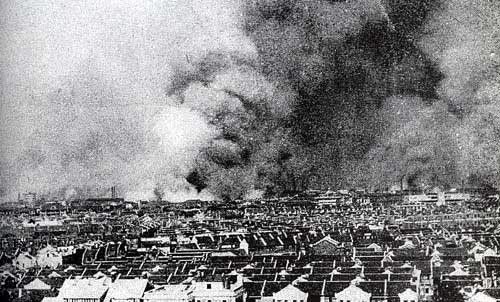
The ground fighting that had broken out on August 13 intensified, and by August 16, it had developed into a massive battle. Both sides poured reinforcements into the northern districts. Hundreds of thousands of civilians, including many hundreds of American women and children, were caught within shell-shot of the combat zones. Those threatened Americans included all the families of CNAC’s American personnel.

U.S. Consul Clarence Gauss recommended they evacuate on the S.S. President Jefferson. It wasn’t mandatory, since the evacuees had to buy passage, but Ernie Allison had a ticket for his very pregnant wife, Florence, when he returned to the Grosvenor House a few minutes after five o’clock in the afternoon on August 16. He tried to break the news to his wife gently, that Florence would have to leave at 9:00 o’clock the next morning. “You know I can’t go on this ship,” he said. “It’s reserved for women and children.”
Florence didn’t fuss. “Yes, I know,” she mumbled. “It was on the radio. I packed a bag. Wouldn’t want you to go under the circumstances.”
Allie was relieved. He was near crazy with work-stress and worry. With Florence was so close to term, Allie thought they might allow her a second bag for the unborn baby.

The guns thundered all night. Florence Allison was awake at 5 a.m. CNAC’s Caucasian personnel did very little work on August 17, 1937. Most were busy supervising the evacuation of their wives, children, and girlfriends. The company truck picked them up. The President Jefferson was anchored in the Yangtze estuary, twenty-miles distant, and the only way to reach it was on a small harbor tender leaving from the middle of the Shanghai Bund.
The harbor tender that was to take the women and children to it was tied up at the Customs Jetty beneath “Big Ching” in the middle of the Bund. The boat wasn’t scheduled to leave until 10:00 a.m., but it was already crowded by the time the CNAC wives unloaded a few minutes after 9 o’clock. A stiff wind whipped Florence Allison’s blue and white polka-dotted maternity dress against her ankles and tousled her hair. She waddled down the jetty onto the tender with 17 other CNAC wives and 14 children.

Harold Bixby shepherded his wife, Debbie, and their four daughters aboard. Twenty-year old Elizabeth, second oldest of the Bixby girls, came aboard clutching the one small suitcase she’d been allowed. In it was a spare pair of pants, a few shirts, undergarments, socks, and all the photographs she’d taken in the three years in China.

Walter “Foxie” Kent, one of the pilots, helped his wife Marie aboard with their five-day old baby – born six-weeks premature and being kept alive in an incubator.
The tender cast off for its run downriver with 411 women and children aboard, far beyond its rated capacity. The tender steamed downriver, its only protection a huge American flag draped over its aft-end.

The women thought they’d been promised a two-hour ceasefire. If so, both sides ignored it. Chinese and Japanese planes bombed north of Soochow Creek. Shrapnel flew all over the city. Elizabeth Bixby and one of her sisters were on deck, in the open air. The small guard of US Marines hustled them below, along with all the other topside passengers, as stray bullets and shrapnel pinged off the tender’s sides.
Beyond Woosung, in the supposed safety of the Yangtze estuary, the overloaded tender pitched and heaved in heavy swells, remnants of the recent typhoon. The boat lurched, slewed, took a long roll to starboard, and very nearly capsized. Women toppled against each other and fell to the floor. A few screamed. Small children, so infrequently stuck alone with their Caucasian mothers, whined, “I want my ahma, I want my ahma.”
The tender wallowed close to the Jefferson. Both vessels tossed wildly. The tender’s captain lost his nerve and refused to draw alongside. A marine shoved him aside, grabbed the wheel, and laid the tender against the liner. On the uprolls, the marines literally threw the evacuees across to the Jefferson’s gangplank. Miraculously, they managed the transfer without hurting anybody.
For the women and children, the drama continued: a few days later, the Jefferson reached Manila just in time for the refugees to get caught in the worst earthquake the city had suffered in thirty years.

* * *
Sources: Florence Allison’s diary, August 16, 1937, entry provided to the author via email by their daughter, Nancy Allison Wright (who was the unborn baby in her mother’s womb.); Kent, Walter C. “Foxie,” “Wings for China,” The Atlantic Monthly, November, 1937; author’s interview with Elizabeth “Bo” Bixby, January 24, 2006.
* * *
Fro those who don’t know much about the Battle of Shanghai, the website World War II Database has a summary.
* * *
“Let There Be Night,” interesting commentary in TheAtlantic.com about Paul Bogard’s book The End of Night: Searching for Darkness in an Age of Artificial Light.
I’m about to start reading Bogard’s book and will hopefully have some review comments when I’ve finished. I’ve seen some pretty astonishing night skies in my time, particularly from the Southern Patagonian Ice Cap in winter and the Empty Quarter of Arabia.
 Tomato Love, a reprise… One of my tomato plants peaked this week, producing a trifecta of obscenely perfect tomatoes that contributed the base layer of a phenomenal caprese salad.
Which of course puts me in mind of the spoken word Tomato Love piece Melissa Fitzgerald and Dina Howard recorded for me a few weeks ago…
And this charming, delightful, and world-record shattering book domino in the Seattle Public Library…
When in doubt…

Sad news: “Iranian trio perishes descending Broad Peak,” published today by Alpinist.
My condolences to their family and friends, and to the Iranian climbing community.


