Fleeing Shanghai, August 1937: what happened to Donald Wong after he was hit by “friendly” machineguns


This post builds directly on Moon Chin’s first air raid, part 2, in which Chinese anti-aircraft gunners machine gunned Donald Wong as he was trying to land a “Tin Goose” Ford Trimotor at Nanking, hitting him ten times…

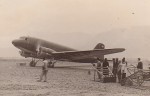
Wong Ford Trimotor
Donald Wong in front of a Ford Trimotor in China

The “friendly fire” holes in his airplane rattled Donald Wong. In Hankow, Colonel Lam ordered him to fly a load of bombs. Like Moon Chin, Donald Wong was an American citizen (like Chuck Sharp, Hugh Woods, Bob Pottschmidt, Hal Sweet, William Bond, or Harold Bixby, for that matter). He’d been born in Chicago. He refused to fly the ordinance. Colonel Lam didn’t care a whit about some piece of American paper. Wong’s blood was Chinese. In Chinese eyes that made him a countryman. Lam threatened to arrest Wong for desertion.

Wong fled to the Hankow foreign concession and tried to get aboard the U.S.S. Luzon, one of the Yangtze Patrol gunboats. The U.S. Navy wouldn’t give him safe harbor. (If Wong were Caucasian, I’ll bet they would have; but then again, if he were Caucasian, Col Lam wouldn’t have threatened him, either.) He took shelter in the YMCA in the Hankow foreign concession, beyond the reach of Chinese law, and refused to leave.

USS Luzon
USS Luzon (PR-7)

Harold Bixby penned a curt letter of protest to Colonel Lam attempting to halt the military missions. “Our American pilots can be a real help to China in maintaining communications in the present emergency,” he wrote. ‘They are as willing and anxious to do their part as we are to have them cooperate.” However, he continued, the provisions of American neutrality forbid them from flying combat missions. “All American pilots in the employ of CNAC have been instructed to remain on the ground until safeguards have been taken to protect American pilots against unauthorized and illegal acts of the nature experienced by pilot Sharp.” (A day or two before, a Chinese officer had held a gun to Sharp’s head and forced him to fly a DC-2 loaded with bombs, China’s Wings, pp. 95-96.)

Donald Wong, 2nd from left; Harold Bixby, 2nd from right; in front of a Ford Trimotor in China
Donald Wong, 2nd from left; Harold Bixby, 2nd from right; in front of a Ford Trimotor in China (Dona Wong collection; click for enlargement)

A few weeks later, in early September, (as is recounted in China’s Wings, pp. 112) Donald Wong was flown to Hong Kong with William Bond, instructed by Col Lam to return to China with a DC-2 that had been “attached” by Pan Am as security against a debt that CNAC owned Pan Am. “Attachment” is how liens were handled in Hong Kong, and it was a hugely complicated situation for William Bond as he attempted to balance the interests of Pan Am, CNAC, the United States, and China.

In Hong Kong and beyond the reach of Chinese authority, Wong quit CNAC instead and took a steamship back to the United States. He returned to the China National Aviation Corporation (CNAC) after Pearl Harbor and flew several hundred Hump missions.

(I’ll resume these stories next week; I might have an off-topic or two to post in the meantime.)

*     *     *

Donald Wong’s experiences: Bond to Kitsi, written in Hong Kong, August 28, 1937, the Bond Papers; author’s interviews with Moon Chin; author’s interview and emails with Wong’s daughter, Dona Wong; author’s interviews with Frieda Chen, Donald Wong’s sister.

“Our American pilots…”: Bixby to Colonel Lam, August 15, 1937, provided to the author via email by Ernie Allison’s daughter, Nancy Allison Wright, November 15, 2005.

*     *     *

China's Wings cover

Share

Fleeing Shanghai, August 1937: the demise of a Tin Goose


China's Wings coverOver a year ago, I started telling the story of CNAC fleeing the Battle of Shanghai in August, 1937 in a series of China’s Wings outtakes. I made several posts on the topic, but then lost the thread and never completed the run of stories. Now, on the cusp of August, 2013, 76 years after the events described, I’m going to return to them. They were all once part of  chapters 8 and 9, “Things Fall Apart” and “The Cavalry.”

For full effect, you should return to the first post and pick up the threads at the beginning:

In addition, any fan of Old Shanghai will enjoy this atmostpheric photostream of 1920s, ’30s, and ’40s Shanghai photos.

Joy Thom, Moon Chin, and Donald Wong in front of a Stinson Detroiter
CNAC’s three star Chinese-American pilots: Joy Thom, Moon Chin, and Donald Wong in front of a Stinson Detroiter, middle 1930s

Okay, now for the first addition to the story collection: “Joy Thom and the end of a Tin Goose,” which fits right onto the end of Moon Chin’s first air raid, part II, when Donald Wong gets shot up by twitchy Chinese anti-aircraft machine gunners while landing in CNAC’s other “Tin Goose” Ford Trimotor:

Joy Thom had a similar experience in CNAC’s other “Tin Goose.”

Joy Thom tried to fly the tin goose to an airfield south of Hankow. Notification went to the destination airfield’s traffic control, but Japanese airplanes were rumored to be everywhere, and nobody at the airfield bothered to tell the local air defense units about Thom’s incoming flight.

They blazed away with their machine guns as Thom eased in to land. Thom firewalled his engines, aborted landing, and turned for Hankow. The weather soured enroute.

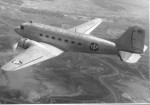
One of CNAC's "Tin Goose" Ford Tri-motors in Western China
One of CNAC’s “Tin Goose” Ford Tri-motors in Western China

Thom couldn’t slip under the clouds; he had to go over the top. The Ford had a radio, but no direction-finding capability. Thom cruised north over an unbroken gray carpet as his fuel supply shriveled.

Finally, Thom spotted a hole in the cloud deck. He spiraled down and made visual contact with the ground, but he didn’t know his exact location. He continued north beneath the cloud ceiling in the hopes of spotting a landmark. He ran out of gas before he sighted anything familiar and force-landed in a marsh.

Thom wasn’t harmed, but the airplane was destroyed.

* Sources for Joy Thom’s Tin Goose flight: Bixby to Morgan, August 25, 1937; Bond to Kitsi, written in Hong Kong, August 28, 1937; both letters in the Bond Papers.

Next: Colonel Lam tries to get Donald Wong to fly a load of bombs; Harold Bixby protests


Share

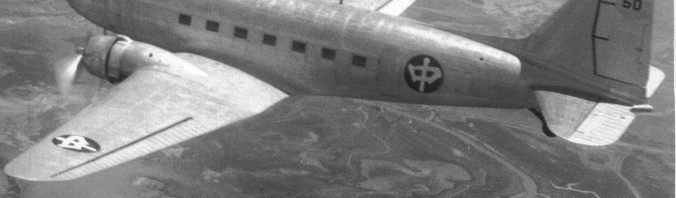
The Douglas DC-3 in China, a photogallery


The Douglas DC-3 is, without doubt, the most successful airplane ever built. Counting all civil and military variants, more than 16,000 were produced. Some 400 are still in commercial use today, 70 years after they rolled off the assembly lines.

The first DC-3 flew on December 17, 1935, the airplane went into commercial service the following April, and it revolutionized the airline industry in the United States.

2011 05 17 cover mock up v2The China National Aviation Corporation (CNAC) got its first DC-3 in 1939. (It had been using the Douglas DC-2 to great effect since the spring of 1935.) In December, 1941, when the Japanese attacked Hong Kong, the airline had three. CNAC pioneered the Hump Airlift in 1942 using DC-3s and C-53s. By the middle of 1943, CNAC was operating about 20 DC-3 variants (C-53s and C-47s) on the Hump, and the airplane remained the mainstay of the CNAC airfleet through the rest of the war.

CNAC flew thousands of Hump missions using DC-3 types.

Here are a few of the best DC-3 photos I managed to collect while researching and writing China’s Wings. (Click on any one and you can scroll through the enlarged images.)

Thanks to Gifford Bull, J.L. Johnson, Steve Michiels, and the Jim Dalby family for use of these photos.

2011 05 17 cover mock up v2Some of the best action in China’s Wings takes place in DC-3s… the DC-2 1/2, the Hong Kong evacuation, the Flying Sieve, Moon Chin flying Jimmy Doolittle out of China, Pete Goutiere’s adventures, and much more.

The DC-3/Dakota Historical Society makes a good effort to maintain the airplane’s history and legacy.

As an aside, check out this guy’s extraordinary DC-3 model made out of LEGO.

I wish LEGO would make a set for a CNAC DC-2 or DC-3 with a Moon Chin minifig!

And if any of you visitors happen to have any other good DC-3 in China photos, I’d be delighted to add them to the gallery.

If you like my posts, please subscribe to my blog with the “subscribe to my blog via email” tool at the top of the sidebar.

Share

The Backyardigans… aka The Invasion of Troop 67


My friend Leesl Herman and 40+ members of West Los Angeles’ Boy Scout Troop 67 spent the night in my backyard last night to break their drive from LA to Campe Wente.

Howling with laughter, a mutual friend asked yesterday before they arrived, “How drunk were you when you said yes to that?”

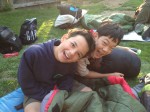
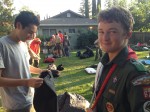
Fears unfounded–it proved a fun night. I gave the troop one of my Enduring Patagonia slide shows, and my son was in hog heaven with 35 other boys spending the night. Here are a few photos of the fiasco:

IMG_4554
West Los Angeles Troop 67


Share

Only in San Francisco


Only in San Francisco:

So, this guy meets this girl in a hacky-sack circle in early February. They get engaged two weeks later. They got in a fight on March 25, and the guy moves out–he moved into a tree in San Francisco’s McLaren Park no less.

He gets cold that first night, goes home, finds the apartment locked and empty, so he huddles up in the backyard, and before too long has passed, his now ex-fiancee comes back from a bar with an ex-Marine with “extensive combat experience”… she hears noises in the backyard, arms herself with a knife and goes out to investigate. The ex-Marine backs her up with a frying pan. (Some Marine–he lets the girl take point?)

The guy attacks them. They retreat to the house. The guy smashes the window and gets in a fight with the ex-Marine. The ex-Marine gets the guy in a headlock while the ex-fiancee gets a neighbor. Shirtless, the neighbor shows up with a can of bear spray and sprays the guy in the face. He throws a rock at the house and flees. He was arrested a few hours later and charged with two felonies.

In court, he was acquitted. Apparently, the ex-fiancee wasn’t a credible witness, and the ex-Marine suffered no apparent injuries. “There was no doubt [the guy] had a terrible night,” said the Deputy Public Defender, “but this case was grossly overcharged. You cannot commit a burglary if you have the right to be in a building. [The guy] had paid rent, made improvements to the house and still had some of his belongings inside.”

Here’s the full story, in the SF Chronicle: “Man Acquitted in Romantic Bear Spray Squabble.”

Don’t neglect the comments thread: “Nothing good ever comes out of a hacky-sack circle. Nothing.”

Well said.

Share