Moon Chin finally gets to meet his father — at age 10


In Wing-Wa Village, Moon Chin grew up with his mother, sister, and brother behind the dingy, sun-seared, windowless exterior walls of a single-story, mud-brick house slowly crumbling back into the earth from which it had been raised. Crunchy lichens sprouted from the roof tiles. The interior was much more cheery, built around a large cistern in an open courtyard, and aunts and cousins inhabited adjacent houses. A few elderly men lazed about the village, whiling away their retirements, but the village was almost entirely devoid of adult, working-age men. For several generations, “old” and “new” Wing-Wa villages had subsisted largely on money sent home by men who worked in Hong Kong, Macau, Canton, or the United States.

The clayey soil around the village wasn’t particularly fertile. Families raised vegetables in small, carefully cultivated plots worked by women and children wearing conical sun hats of woven bamboo, and they manufactured their growing soil by mixing sand and “night soil” fertilizer – human excrement they assiduously refused to let go to waste. A low mud brick wall surrounded the village, built more to pen in pigs and chickens than it was to keep bandits or wild animals at bay, and a small tree- and weed- covered hillock rose behind the hamlet. It was a thoroughly unremarkable place.

Moon Chin started school at age nine, attending class in a one-room building. He studied Chinese characters and began learning to read, but halfway through the year, Moon’s mother received a letter from her husband that changed Moon’s landscape entirely. Penned by a Chinese scribe in America since Joe Chin could neither read nor write, and read aloud by one in China since Moon’s mother was similarly illiterate, the letter announced that Joe Chin would come home in the spring of 1923, and that Moon Chin would return with him to the United States the following year.

Day after day, Moon Chin asked when Father would arrive. Mother had no idea. She only knew he was coming, the letter hadn’t said when. Moon Chin wondered what his father would be like, and what it would be like to cross an ocean. Time stretched into weeks, then months, but one day Moon Chin’s father was home, a grown man leaving large footfalls on the tile floors and basking in the glory of being home from Gum Shan, the Gold Mountain. Moon spent the next year pleading for stories about the strange land peopled with red-haired foreign barbarians. His father waxed on and on about the economic opportunities he’d discovered in a place called Baltimore.

Next: Moon Chin goes to America — and the country welcomes him by putting him in jail.

Share

How the SF earthquake made Moon Chin a citizen, Part III


Continued from yesterday, part 3 of 3…

At 5:12 a.m. on April 18, 1906, the San Andreas Fault ruptured off the coast southwest of San Francisco, triggering a monstrous earthquake that hammered the city for 45 seconds, collapsing and toppling buildings. Fires sprang up in the wreckage, and the many small conflagrations burned together until they’d merged into a massive flaming maelstrom that raged for three days, devoured 490 city blocks and left 225,000 people homeless. As many as 3,000 people died in the twinned catastrophes.[1]

Chinatown was devastated. Most Chinese survived the disaster with nothing besides what they’d physically carried from the flames, but the apocalyptic devastation held a surprise benefit for poor, working-class Chinese who’d been denied the opportunity to naturalize by the Exclusion Acts of the last three decades – among the 28,188 destroyed buildings were San Francisco’s City Hall and the Hall of Records. The quake-sprung fire had incinerated the city’s birth and its citizenship documentation. Like thousands of Chinese all over the United States, Joe Chin swore he’d been born in the ruined city. The immigration service couldn’t prove otherwise, and United States v. Wong Kim Ark made them all American citizens.[2]

Thus minted a citizen, Joe Chin worked in the United States for another six years, sending money to his family in China all the while. In 1912, he returned to Wing-Wa village to see his wife, daughter, and the nine-year old son he’d never met. His wife became pregnant again during his visit, and 9 months later, under mosquito netting attended by a midwife, she gave birth to a third child, a son they named him Moon Fun Chin.

Soon after the birth, Joe Chin returned alone to the United States. He couldn’t take his family because his two older children would destroy the post-earthquake fiction he’d built with the U.S. immigration. However, when he reached U.S. soil, Joe Chin announced to American authorities that he’d married and fathered a son while in China. Joe Chin was an American citizen, and any child he fathered, anywhere in the world, automatically qualified for citizenship. Moon Fun Chin may have been born in an obscure South China village, and he may have learned Cantonese ten years before he ever heard English spoken, but he was born an American citizen  – courtesy of the San Francisco earthquake.[3]

Tomorrow: Moon Chin finally meets his father — at age ten.


[1] Chang, Iris, The Chinese in America, footnote to page 146: “Between 1855 and 1934, a child born abroad legally gained U.S. citizenship if his father was a U.S. citizen at the time of the birth, and had lived in the United States before the birth.”

[2] SF earthquake; also, Winchester, Simon, A Crack at the Edge of the World.

[3] Moon Chin’s story of his father obtaining U.S. citizenship in the earthquake: author’s interviews with Moon Chin; Chang, Iris, The Chinese in America, pp. 145-147, corroborates the fact that many Chinese obtained American citizenship after the San Francisco Earthquake; as does Winchester, Simon, A Crack at the Edge of the World, pp. 343-350.

(Winchester is a superb writer, I highly recommend his books, particularly The Map that Changed the World and The Professor and the Madman, both bestsellers. A little more obscure, but relevant to my work on China’s Wings, is The River at the Center of the World, about the Yangtze. Iris Chang is also good, and I suggest both The Chinese in America and her Rape of Nanking.)

Share

How the SF earthquake made Moon Chin a citizen, Part II


Continued from yesterday.

Predictably, the Chinese suffered a backlash. Working-class whites felt that disciplined Chinese toil forced them to work harder for less pay. In 1871, a dozen Chinese were killed in a Los Angeles race riot – including a 12 year-old boy hanged by a Caucasian mob; in 1877, ten thousand disgruntled whites laid siege to San Francisco’s Chinatown in a three-day orgy of hatred, arson, looting, and assault. Fear of the “Yellow Peril” led President Arthur to sign the Chinese Exclusion Act in 1882, which imposed a ten-year ban on the immigration of Chinese laborers and denied Chinese persons the right to naturalize as U.S. citizens. Congress made the Exclusion Act even more onerous in 1884, amending it to allow only those Chinese persons who had been in the United States prior to 1880 the right to travel freely between the two countries. The legislation seemed to legitimize anti-Chinese pogroms. Twenty-eight Chinese were murdered in Rock Springs, Wyoming, in 1885. An indemnity was paid, but there were no prosecutions – the Federal government told Chinese diplomats that it wasn’t responsible for crimes committed in a territory that wasn’t yet a state. In February, 1886, President Grover Cleveland declared martial law and sent Federal troops to Seattle to quell a series of anti-Chinese riots. The following year, 31 Chinese miners were murdered and robbed in Hell’s Canyon, Oregon. The Chinese Exclusion Act expired in 1892, but Congress passed the Geary Act to extend the ban for another ten years. When the Geary Act expired, Congress made the ban permanent.[1]

Despite the egregious persecution, the Chinese in America continued to work hard at difficult, low-paying jobs, saving money and improving their lives. They formed legal associations to protect themselves and seek redress from some of the systemic ills. In 1895, U.S. immigration officials detained Wong Kim Ark, a 21-year old man who had been born in San Francisco, and denied him the right to reenter the United States on the grounds that he was an unwanted person of Chinese blood. Wong Kim Ark counter-claimed that his birth on U.S. soil granted him the full rights of American citizenship, regardless of his racial ancestry. United States v. Wong Kim Ark went to the United States Supreme Court, and on March 28, 1898, the court ruled in Mr. Wong’s favor. Article I of the 14th Amendment to the U.S. Constitution, ratified in the aftermath of the Civil War, was quite explicit on the subject – “All persons born or naturalized in the United States, and subject to the jurisdiction thereof, are citizens of the United States.”[2] The decision would have far-reaching consequences in the lives of Joe Chin and that of his son.

Joe Chin came to the United States at a time when immigration policy made it very difficult for Chinese laborers to enter the country. In 1903, the Immigration and Naturalization Service (INS) rejected one-quarter of the Chinese trying to enter the United States.[3] But somehow, it isn’t known how, Joe Chin did manage to enter. He might have succeeded in classifying himself as a merchant or a student and thereby eluded the Chinese labor ban. He may have bribed a corrupt immigration official, of which there were many. He might have slipped into the United States surreptitiously. Possibly, he was accepted through proper channels. Once on American soil, like many other Chinese immigrants, Joe Chin gravitated to San Francisco. He took lodgings in Chinatown, found a job, and began sending money home to his family. Three years after Joe Chin’s arrival, the San Francisco earthquake made him an American citizen.

Part two of three, continued tomorrow… Part III


[1] Los Angeles riot of 1871: Chang, Iris, The Chinese in America, pp. 121; pillage of Chinatown in 1877: Ibid., pp. 127; Chinese Exclusion Laws: Ibid., pp. 132-156; Rock Springs massacre: Ibid. , pp. 133-134; Seattle anti-Chinese pogram: Ibid., pp. 133; Hell’s Canyon massacre: Ibid., pp. 134-135; the Geary Act, its expiration, and the extension of the ban on Chinese immigration: Ibid. , pp. 136.

[2]United States V. Wong Kim Ark, one of the great civil rights decisions.

[3] The one-quarter rejection rate is the statistic for 1903: Chang, Iris, The Chinese in America, pp. 142.

Share

How the SF earthquake made Moon Chin a citizen, Part I


Moon Chin was born on April 13, 1914 in Wing-Wa Village, a tiny hamlet in the undulating coastal lowlands of Kwangtung Province about 60 miles up the Pearl River from Macau and a half a day’s walk west of the riverbank — a place so obscure that it didn’t have its own store. Moon wouldn’t hear English spoken until he was ten years old, but he was born an American citizen courtesy of the worst natural disaster in U.S. history.

In order to understand how that came to pass, one has to jump back a generation to Chin Kwok-tung, Moon Chin’s father, who was born in 1880. Around the turn of the 20th Century, Chin Kwok-tung married a young woman from the nearby Toi clan, the result of a rigorous inter-family negotiation mediated by a professional matchmaker. As was customary, he didn’t lay eyes on his bride until the wedding. In 1902 or 1903, Chin Kwok-tung anglicized his name to Joe Chin, left his infant daughter and pregnant wife, and crossed the Pacific Ocean crammed into the steerage hold of a side-wheel steamer, one of the tens of thousands of impoverished Chinese men who had left South China in the last fifty years and sailed to the United States, lured to Gum Shan, the “Gold Mountain,” by stories of easy-made wealth and wide-open opportunity. Some of which were actually true. A few Chinese had struck riches in the California Gold Rush; others staked land and made money in agriculture; some began successful business ventures. The vast majority didn’t enjoy such good fortune, however, but the United States did afford them opportunity to work hard, and for the most part, to retain their earnings.[i]

In harsh western conditions, Chinese labor had proved to be a foreman’s dream. Between 1864 and 1869, more than ten thousand Chinese men worked sunrise to sunset, six days a week, braving landslides, blizzards, and avalanches in the Sierra Nevada and withering heat in the Great Basin deserts to hack, shovel, chisel, drill, blast, and carry the hundreds of thousands of tons of earth and rock necessary to build the western half of the transcontinental railroad, 690 miles of Central Pacific track laid east from Sacramento, California to Promontory Point, Utah. From 1870 to 1885, thousands of Chinese men mucked through thigh-deep tule swamps constructing the levees, dikes, and drainage ditches that converted five million acres of the Sacramento River Delta into productive farmland. In other parts of the country, Chinese immigrants worked in mines, canned salmon, opened shops, restaurants, and laundries . Chinese labor contributed hundreds of millions of dollars to the economic development of the United States and they did it for wages their Caucasian counterparts considered unacceptable.[ii] The Chinese are “quiet, peaceable, tractable, free from drunkenness, and as industrious as the day is long,” wrote Mark Twain in Roughing It in 1872. “A disorderly Chinaman is rare,” he continued, “and a lazy one does not exist.”[iii]

Part one of three, to be continued tomorrow… Here’s Part II


[i] Joe Chin’s history and details of Moon Chin’s early life: Moon Chin’s Oral History; author interviews with Moon Chin, September 10, 2004, September 17, 2004, July 15, 2005; telephone follow-ups in the summer of 2005; Moon Chin isn’t sure exactly when his father first came to the United States. He thinks 1902 or 1903 is most likely. The majority of overseas Chinese hailed from South China: Bixby, Harold M., Topside Rickshaw, Chapter VI, pp. 59; author’s interview with Moon Chin, September 17, 2004

[ii] Transcontinental Railroad statistics: Chang, Iris, The Chinese in America, pp. 53-64; five million acres reclaimed in the Sacramento River delta: Chang, Iris, The Chinese in America, pp. 72-73. Chang’s book is excellent. I also highly recommend her Rape of Nanking, an important but extraordinarily disturbing book. Chang’s website.

[iii] Twain, Mark, Roughing It.

Share

Moon Chin joins CNAC


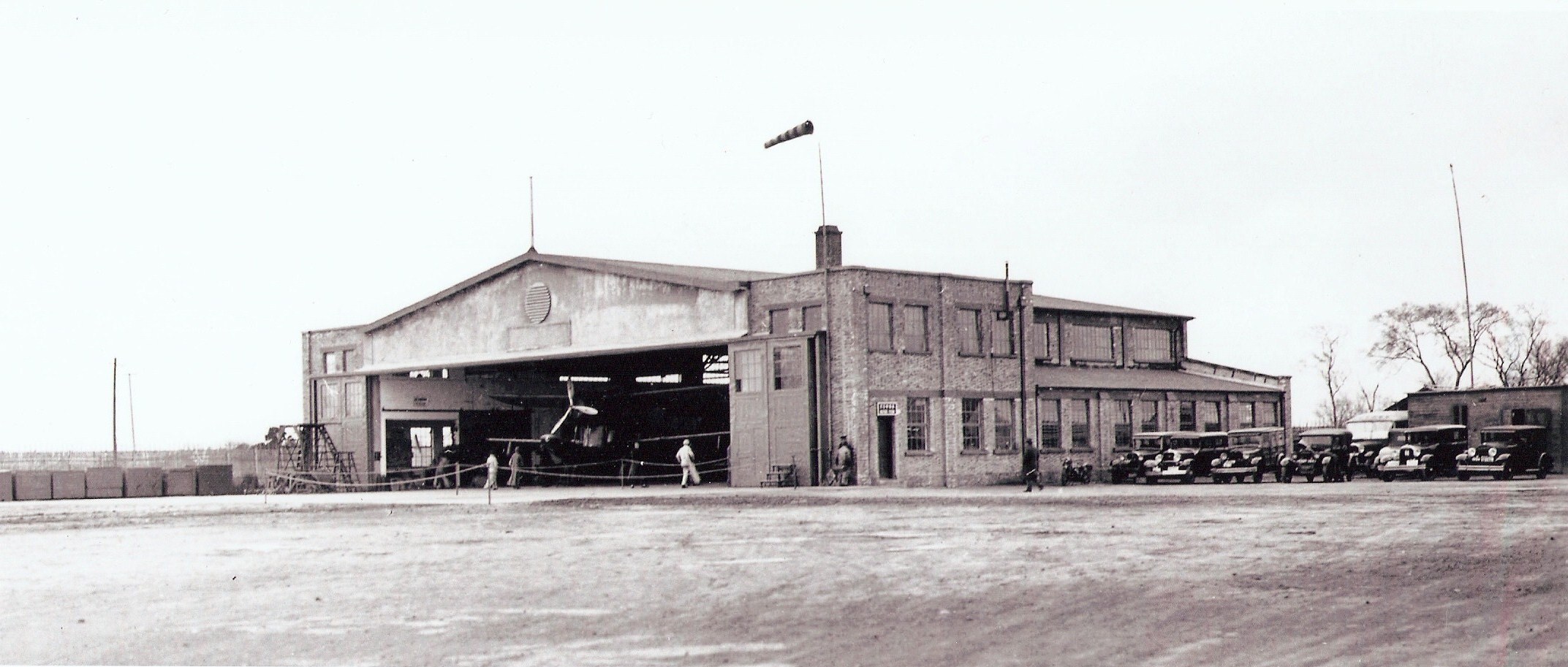
CNAC hangar at Lunghwa Airport, early 1930s. (Nancy Allison Wright)

A windsock hung limp from a pole that sprouted from the roof of the largest commercial hangar in China; it might have been the largest in Asia, capable of holding six single-engine airplanes. A line of offices snuggled against the side of the building closest to the river, and a door accessed the gravel parking lot where Moon Fun Chin, a callow, smooth-faced Chinese wearing his best suit under a heavy winter coat, stood watching the proceedings with his “little uncle” – his father’s younger brother. Moon Chin had recently learned to fly, and he awaited the attention of William Langhorne Bond, the thirty-nine year old, ruddy-faced, former gravel contractor who walked back from the dock with his gray overcoat drawn tight over a carefully-tailored suit. As Bond came closer, Moon saw that he had a thin face and a bent nose that looked like it might have once been broken. Close-cropped strands of reddish hair showed beneath his hatband, and the toothbrush mustache that edged past the corners of his mouth drew attention from piercing, gray-blue eyes. They had an appointment. Moon quashed his anxiety and did his best to look steady and responsible. He was three months shy of his nineteenth birthday, and he’d never met such an important man.

Bond furrowed his brow and studied the young Chinese. His cheeks sank toward his jaw line. Then he smiled. Bond never could hold a scowl for long. He loved aviation, he loved China, and he ran the China National Aviation Corporation, China’s most important airline. Moon Chin didn’t know much about William Bond, not then, but he wanted something from the American very badly in that hard winter of 1933, and he’d come halfway around the world to get it: He wanted a job.

Next: How the San Francisco earthquake made Moon Chin a citizen, Part I


Share

Three great pilots


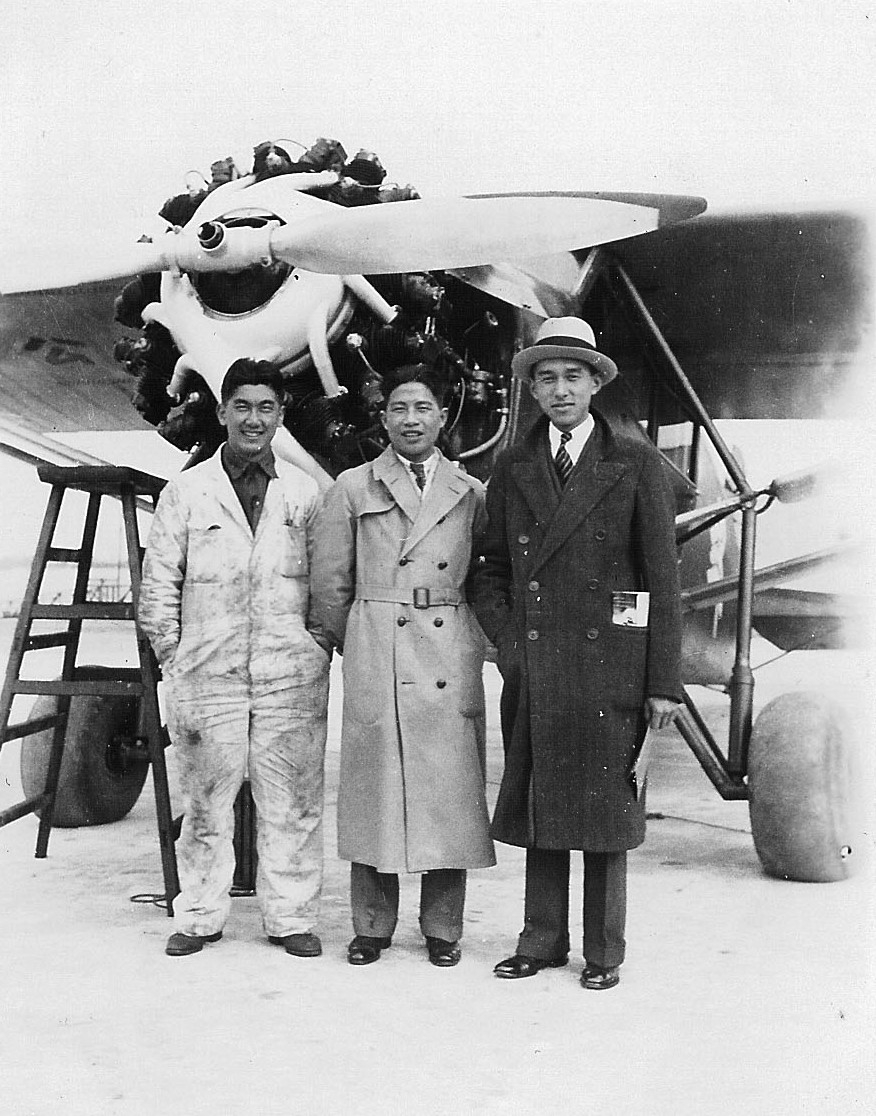
Joy Thom, Moon Chin, and Donald Wong in front of a Stinson, middle 1930s (Dona Wong photo — Donald’s daughter)

CNAC’s first three Chinese-American pilots: Joy Thom of Los Angeles, Moon Chin of Wing-Wa Village and Baltimore, Donald Wong of Chicago. All three were born American citizens, all three earned only one-third as much as their Caucasian counterparts – for exactly the same work and responsibility, and all three triumphed against whatever adversity they faced.

They began flying for the airline as co-pilots in the winter of 1933, when CNAC opened its “Route Two”, from Shanghai to Peiping (Bejing), and by 1936, all three had checked out as pilot captains. Joy Thom was killed in early 1941, trying to sneak under a storm flying a planeload of Chinese currency into the interior from Hong Kong; Moon Chin is alive and well today, living in Burlingame, CA and driving a jet-black Mercedes everywhere at 90 mph; Donald Wong flew for the airline 1933-1937, and again from 1942-1945, and the success of his life is perhaps most easily measured by his daughter, Dona Wong, a PhD on the faculty of Harvard University, who provided the above photo.

Writing about these three men was one of the great joys of China’s Wings.

Next: Moon Chin joins CNAC

Share

All roads led to Moon Chin


Moon Fun Chin - NewHorApr1943 1 copyI’ve been focusing on whipping the China’s Wings manuscript into shape with Tracy Devine, my editor at Bantam Dell, and I’m thrilled with the advice she’s giving, but it’s been soaking up all of my writing energies. We’re still plugging along, but this morning I’m finally going to pick up the story of China’s Wings where I left off weeks ago, with me coming back from New York having just signed a contract to write a book about CNAC flying the Hump during the Second World War and having just interviewed Shirley Wilke Mosley, daughter of chief mechanic O.C. Wilke.

Well, Shirley’s stores and her father’s photo albums sent me home fascinated with the story of the airline prior to Pearl Harbor, but I could only develop that aspect of the airline’s saga if I could locate a trove of primary sources from which to flesh out a lively, colorful narrative. Those sources could be of two basic types: on the one hand, original letters and documents; on the other, interviews with surviving airline veterans who’d flown or worked for CNAC prior to December 8, 1941 (which, due to the effects of the International Date Line, is Pearl Harbor Day in the Orient).

T.T. Chen, Harold Chinn, and Nancy Allison at the 2005 C.N.A.C. reunion (cnac.org)

There wasn’t any rush to find sources of the former type — if they existed, they’d be resting undisturbed in various archives around the country, where they’d been for most of the last half century, but there was an enormous hurry to get to the people who’d worked for the airline before Pearl Harbor. By 2004, time had winnowed their ranks to a very small group. Four, to be exact: Harold Chinn, T.T. Chen and Frieda Chen, and Moon Fun Chin.

Moon Chin in 1941
Moon Chin in 1941
T.T. Chen mixing a martini at Moon’s house in 2004 (cnac.org)

Although Harold Chinn’s son Craig lived a mere mile or two from my Walnut Creek apartment, Harold wasn’t at all in good health. Harold Chinn had incredible adventures flying for the airline from 1937-1949, but his memories were slipping. Frieda Chen’s brother Donald Wong was one of the airline’s three original Chinese-American pilots and she’d been married to CNAC pilot Paul Chinn until he was killed in early 1941, when she began working as Company Secretary.  In 1943, she married Chen Teh tsan, T.T. Chen, an operations man who’d joined the airline in 1939. Frieda’s a spicy little fireplug, T.T. was one of the kindest men I’ve ever known (and the mixer of a truly great martini), and although both of them provided great supporting interviews and helped me understand many facets of pre-war China, neither had been at the core of events through the 1930s. If I were to truly develop the airline’s story through the decade before Pearl Harbor with the help of an eyewitness, I’d need the help of Moon Fun Chin, who started flying for the airline in the winter of 1933 and stayed with them until after the Japanese surrender, in the late summer of 1945.

Moon Chin presiding over the 2005 reunion (cnac.org)

Happily, Moon Chin lives in Burlingame, just south of San Francisco, not far from my home, and I approached him with trepidation, well-aware how much of my project depended on his good graces…

[A run of Moon Chin stories starts at  Three Great Pilots.]

Share

The Chungking Airport, probably in 1938


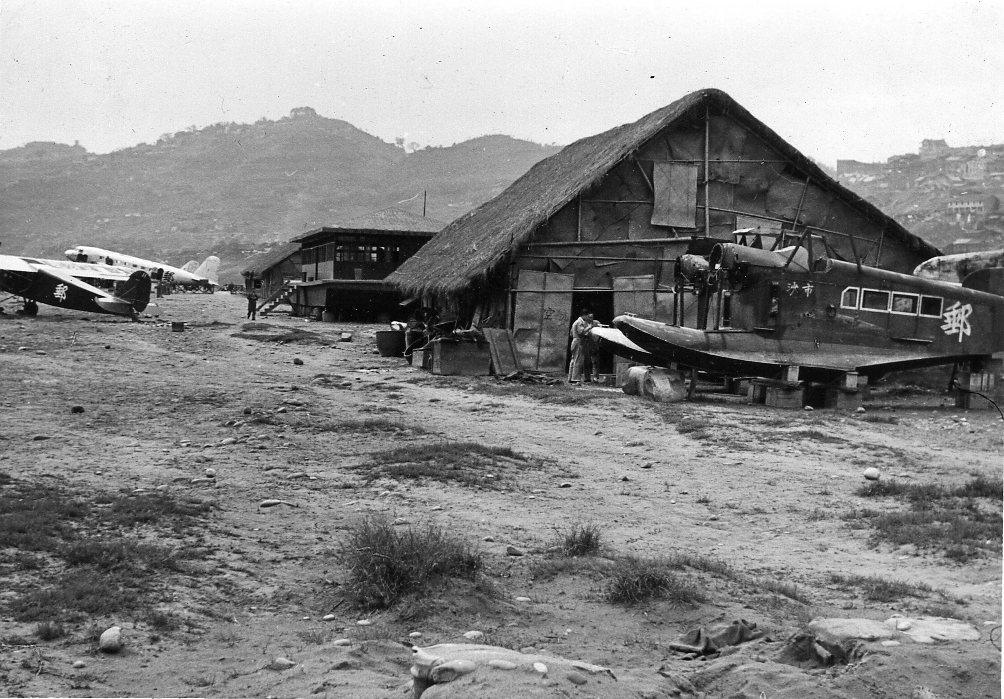
Ramshackle constructions on Chungking’s Sanhupa Airport, which was build on a sandbar island in the Yangtze below the city. (Shirley Wilke Mosley Collection)

Chungking’s Sanhupa Airport, probably in 1938, which had the feel of a frontier colony. Because it was built on a Yangtze sandbar, all the buildings on the island were temporary, so they could be moved uphill and inland on short notice — floods submerged the island every summer, usually to a depth of thirty feet, swooshing a 12-knot current over its top. In the middle 1930s, an army of coolies had ferried locally quarried stone slabs to the island and jigsaw puzzling them into a 2,150 foot runway that could survive the floods. It also proved to be nearly-bomb proof — the Japanese started attacking Chungking in 1939, and their raids continued for three years. They never knocked it out of action.

On the flightline are two DC-2s and a Stinson Detroiter. Against the building in the foreground are the carcasses of two Loening Air Yachts.

Share