Here’s an interesting article about the gorgeous geologic map of Yosemite’s El Capitan produced by Roger Putnam, a veteran Yosemite climber and master’s candidate at the University of North Carolina.



Here’s an interesting article about the gorgeous geologic map of Yosemite’s El Capitan produced by Roger Putnam, a veteran Yosemite climber and master’s candidate at the University of North Carolina.
I’m happy to announce that the June issue of GEO magazine has my article about the Hump Airlift on its cover — a great platform from which to stump for China’s Wings and laud the pioneering efforts of William Langhorne Bond and the China National Aviation Corporation.
 I haven’t yet held a hard copy of the magazine, but it’s available electronically by installing the GEO App on your tablet or smartphone and then buying the issue. (The app is free: here’s the link for Apple devices, and here’s the Android link.) I’m truly chuffed with the eArticle, and it has a bunch of enhancements, including a great World War II newsreel about the Hump operation.
(Installing the GEO app is free; buying the issue costs $5.99)
Fellow CNAC-enthusiast and GEO editor Kai Friese worked up the piece with me and wrote the excellent companion story In Search of Ship 58 about his expedition to the crash site of CNAC No. 58, the plane in which Joe Rosbert and Ridge Hammell crashed on April 7, 1943, beginning their epic 47-day walkout to civilization. Amazingly, Kai located Mingah Ramat, one of the Mishmi women whose family sheltered Rosbert and Hammell after the crash. Kai’s eArticle enhancements include a video of Mingah Ramat giving her impression Rosbert crawling across the floor of her hut. That scene is one of my favorites in China’s Wings, and it’s mind-boggling to see it reenacted by an eyewitness — and I’m relieved to see that I imagined it correctly.

How Man Wong, President of the China Exploration and Research Society (CERS), wrote the second companion article, The Veteran, about the amazing life of Moon Fun Chin.
I hope you enjoy the stories. The issue also has an interesting article about Adolf Hitler’s youth and rise to power.
It’s worth installing the app for GEO’s German edition (Apple; Android), because once you’ve installed the app, they offer a free sample issue (with a reddish cover that says ‘WUNDER’). It’s got an astonishing feature of climbers ascending the Roraima Tepui and a flabbergasting 360 degree image taken from the top.
My gratitude to Kai Friese for allowing me to contribute to his Hump project.
China’s Wings; Enduring Patagonia; Right Mate, Let’s Get On With It; Rope Diplomacy; Into Action.
Eddie Phay posted a 22 minute climber’s-eye video of an ascent of Shaken, Not Stirred on Vimeo. Crazy cool to watch their ascent and have it feel so familiar. Watching it, I felt like I knew exactly where the next stick of the pick was going to land and where the next gear was going in. Also interesting to watch what has changed in climbing since Jim and I made the route’s FA in 1997. (Damn, those axes and screws look good… and so do those gloves.

Here’s my account of making the route’s first ascent with Jim Donini, in May 1997.
Here’s a wonderful 2:50 minute film made by a French tourist in New York in 1939 — and it’s in color! (Great soundtrack, too.)
Cars, dresses, hats, suspenders, elevated railways, Harlem, and more, it ends with a great pan of the Chrysler Building and the Empire State Building from the observation deck of the Rockefeller Center.
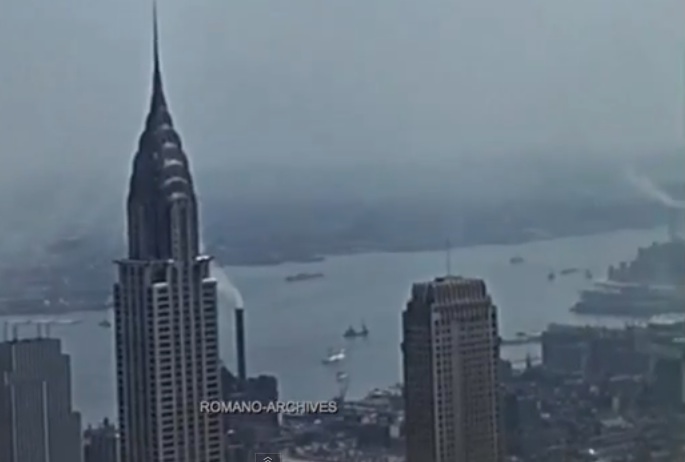
William Bond, main character in China’s Wings, spent the first three months of 1939 in the United States, and he went to New York several times to meet with his corporate superiors at Pan Am headquarters — which was in the Chrysler Building. This film shows his exact milieu.
I would imagine those visits included lunch and lunchtime martinis in the Cloud Club, the former speakeasy built under the stainless steel carapace on the top floors of the Chrysler Building.
Another artistic truth etched in the Sistine Chapel ceiling:
“When will it be done?” growled the Pope.
“When it’s finished, [expletive unspoken],” replied Michelangelo.
[A joke cribbed from a manuscript I’m reading.]
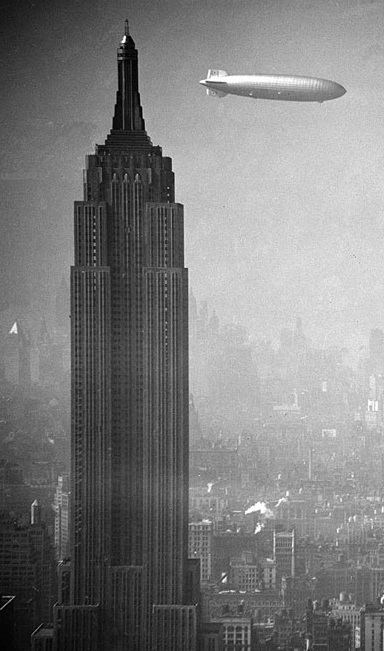
Moon Chin, one of China’s Wings main supporting characters, told me about the huge impression seeing the Graf Zeppelin over Baltimore made on him when he was a boy.
Here’s an incredible run of Hindenburg photos published on The Atlantic’s website.
A partnership between Lufthansa and the Nationalist Chinese government, Eurasia Airlines was CNAC’s great commercial rival through the 1930s and early ’40s.
An email correspondent just brought this superb photo to my attention. It shows one of Eurasia’s Ju-52s, and he asked if I thought it was taken at Chungking’s Sanhupa Airport, a cobblestone airport built on a Yangtze sandbar below the city.
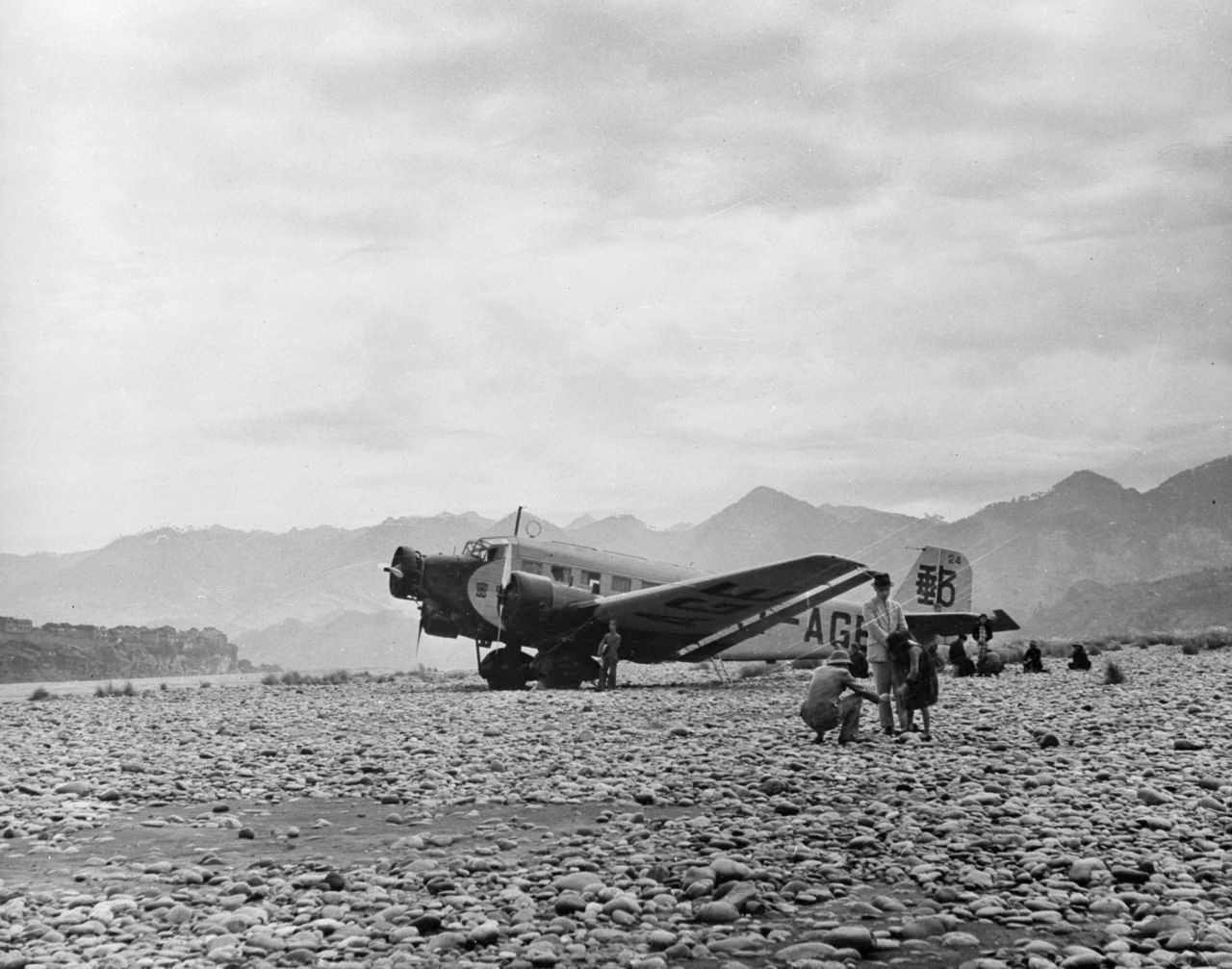
I told him that I thought so, but then decided to see if I could figure it out for sure.
Comparing the hills in the background with this photo, which I know was taken at Sanhupa, I think it’s a definite confirmation.

The two hilltops immediately right of the pole in the picture above are an exact match to the two hilltops at the extreme right of the Ju-52 photo.
I’ve been staring in slack-jawed astonishment at this adventure footage from Renan Ozturk, especially at the spectacular scenes in Alaska’s Ruth Gorge that start near the midpoint. Looks to me like those scenes were taken high on the SE Buttress of Mount Dickey, a mountain that makes a cameo appearance on my recent post about the first ascent of Shaken, Not Stirred. The other route that Jim Donini and I did in the Ruth, The Bourbon Bottle Route, doesn’t quite show up in any of the clips, although Mount Bradley, the mountain it is on, does appear two or three times.
Renan’s footage also puts the Ruth into its proper scale, which none of my pictures ever accomplished.
Check out Renan’s short, it’ll be 3:11 of well spent, inspiring time. I used to live in that world. I’d like to get back to it.

Amongst a lot of great climbing in the mid- and late- 1990s, my Enduring Patagonia years, Jim Donini and I made the first ascents of what struck me as three truly world-class alpine climbs: in Patagonia we did The Old Smuggler’s Route on the north face of Aguja Poincenot and A Fine Piece on the west pillar of Cerro Pollone, and on the south face of the Mooses Tooth in Alaska’s Ruth Gorge, we did Shaken, Not Stirred. None was cutting edge in terms of difficulty, but all three were incredibly beautiful; Sophia Loren kind of beautiful.
I’ve always been astonished and grateful that we were able to get onto three such marvelous climbs. Recently, I shared pictures and stories from A Fine Piece. Here, I’m going to post about Shaken, Not Stirred.
First, I need to take issue with the story Jim told Joe Puryear, author of the Supertopo guidebook Alaska Climbing, in which Jim waxes poetic about how he and Jack Tackle had always had their eye on the climb that would become Shaken, Not Stirred but had never gotten around to climbing it. I’ve also heard him talk about how we spotted Shaken, Not Stirred from the summit of Mount Bradley, after we climbed The Bourbon Bottle Route.
Ahhhh….. that’s not how it happened.
(I’m reserving the right to needle Jim here because he’s one of my best friends, definitely the best climbing partner I’ve ever had, and unless your last name is Tackle, Lowe, Bragg, Kennedy, or Engelbach I’m not extending you the same right.)
So here’s how it actually went down. Without any concrete objectives, Jim and I flew into the Ruth in May of 1997 with Kent McClannan and Jurgen Grunevald. Jim was familiar with the area thanks to the expeditions he’d made into the Ruth with Jack Tackle, he and I had done The Bourbon Bottle Route on the south face of Mount Bradley the year before, and I had photocopies of all the American Alpine Journal entries pertinent to the Ruth Gorge. Our plan was to fly in there and “take a look around,” “see what we could find,” and “hopefully get up something.”
We started scouting possibilities soon after Paul Roderick of Talkeetna Air Taxi slipped under the cloud layer and dropped us on the Ruth. (I loved flying with Paul, a real kindred spirit.) Kent was partnered with Jurgen, and I was with Jim, but it was Kent and I who went together to scope the enormous and imposing south face of Mount Dickey. We saw nothing attractive, but I thought to set up my camera tripod and take a zoom lens shot of the south face of the Mooses Tooth with the the bottom of Dickey’s southeast buttress in the foreground.
One peek through the lens changed everything.
Here’s the picture:

The Ham and Eggs couloir (first ascended in 1975 by Jon Krakauer, Thomas Davies, and Nate Zinsser) was clearly visible running up the sun/shade line left of the Tooth’s main summit, but what really caught my eye was the other couloir, the one just into the shade between the west and middle summits. It doesn’t show up too well in this scan, but through the camera lens I could see what looked to be a thin runnel of ice running up slightly to the right of the prominent snowfield high in the couloir and then merging into it not too far beneath Englishman’s Col — the high col between the Tooth’s west and middle summits.
The runnel looked viable, and it looked good.
It looked really good.
Looking through the lens, collecting my thoughts and trying to keep calm, I also realized that I had a problem: I was with Kent, and I didn’t want him and Jurgen to scoop the line. Both were good climbers, and given any opportunity, they’d nail it. Which wasn’t lost on me. So I kept quiet, even though I was quivering with excitement.
There are two things in this world I’m good at keeping quiet over: things I’m told in confidence and new-route possibilities. (Fifteen years later, I’m still sitting on some good ones.) And having spotted the Shaken, Not Stirred couloir, I’d sooner the Mooses Tooth fall over than have somebody other than me grab its first ascent.
Back to camp, I whispered to Jim about what I’d seen and threatened violence if he let on. He took a “ski around” and got himself a vantage. He liked what he saw and we organized a sortie.
We left the tent about midnight, climbed the icefall where the Root Canal Glacier tumbles into the Ruth Gorge to the base of the south face of the Mooses Tooth, and started up the route about six a.m. It didn’t take us long to realize that we were onto something really special. A pitch or two of hollow, rotten ice gained a straightforward couloir, and we climbed that for a long way, until it pinched down to the beautiful ice runnel I’d seen from the opposite side of the Ruth.
Here’s a good overview of the route that I found on the web. The coming photos will make more sense if you click on it and bounce back. Plus, you’ll see why it’s such a great climb.
And here’s Jim in an easy part of the couloir. I think he’s about to launch up into the narrow ice runnel.

The ice runnel served up the best climbing on the route. Jim got the best of it, and it was fabulous. Below is a shot of Jim copping a rest near the end of a long pitch:

Jim led the bulk of the runnel, which I think went on for four pitches. I got the last one. Here are two pictures of me that Jim took on that pitch (I think):


The couloir walls framed spectacular views into the Ruth Gorge. The picture below is an odd converse of the one I’d taken below Mount Dickey the day before, perhaps showing why the route hadn’t been discovered, since only a small slice of the Alaska Range is visible from inside the couloir’s depths.
As I recall, it wasn’t easy to find anchors in the mostly flawless granite beside the snow and ice, but when I did get a stance, I took this picture of Mount Dickey.

A bit farther up, I led the crux of the route, a short, sharp mixed step that wasn’t very well protected. I took off the pack to do it:

I was pretty psyched to get over that step. Above it, I could see that the route would “go” all the way to Englishmen’s Col, and except for a funky move over a snow mushroom that got us back into the main snowfield, it was mostly cruising — in a truly spectacular alpine setting.
Here’s Jim kicking back in Englishman’s Col while we brewed tea.

Jim taking in the sights:

In the other direction, we had an incredible view across the upper north face of the Mooses Tooth, which was holding the day’s last sunshine.

We climbed up and over the west summit of the Mooses Tooth and spent the rest of the night descending to basecamp. Here’s me just after arriving:
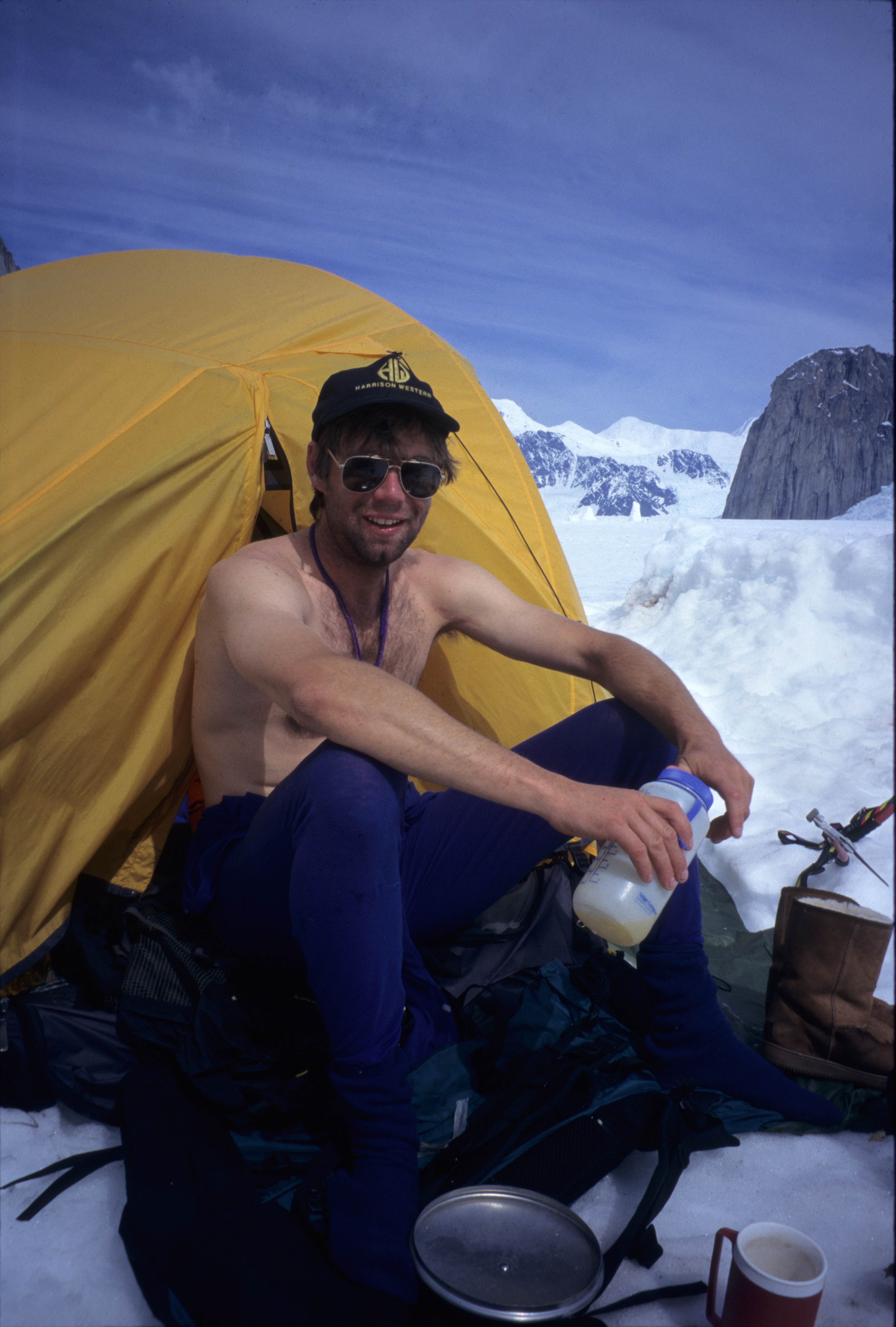
Despite two nights without sleep, it didn’t take us long to graduate from hot Tang.
The Shaken, Not Stirred couloir is directly over Jim’s head.

I was delighted. I knew we’d scored a really good first ascent, and it became popular in a hurry, especially once Paul Roderick reduced the approach to five minutes by landing people on the Root Canal Glacier directly below the climb. People with good weather could suddenly knock out both Ham & Eggs and Shaken, Not Stirred in a single weekend.
Here’s what Joe Puryear’s guidebook has to say about Shaken, Not Stirred: “This narrow ice ribbon splitting the immense granite walls of the south face of the Mooses Tooth is an alpinist’s dream. Although it doesn’t provide an easy way to the actual summit, the outstanding nature of the climbing makes it exceptional. And with its easy access and short approach, this is about as good as it gets for Alaskan alpine climbing.”
Makes a guy blush.
As further evidence of my version of the route discovery story, I offer up the phone call I made to Jack Tackle as soon as we were back in civilization: “Dude, how’n the fuck did you miss that?”
Jack wasn’t too happy with my gloating (and probably wanted to beat me to a bloody pulp), but at least he had the Elevator Shaft and the Cobra Pillar to ease his pain.
I’d been giving Jim a hard time along those lines ever since we were in Englishman’s Col.
If you’ve got Shaken, Not Stirred stories of your own, please post ’em or link to ’em below — along with photos.
Here are good Shaken, Not Stirred photos from Ouray Ice Climbing.
Here’s the American Alpine Journal mention of the second, third, and fourth ascents of Shaken, Not Stirred in 2000, three years after we’d done the first. Kelly Cordes is a friend of mine. I’d forgotten that he’d done the second ascent. Very cool.
Here’s a 22 minute climber’s-eye video of an ascent of Shaken, Not Stirred on Vimeo. I remembered every placement…
 I just discovered this interview with my great climbing partner Jim Donini which was done by Denali Mountaineering in 2000. Lots of fun.
Here’s a link to the audio.