Here’s “In Flight,” a fabulous interactive website from The Guardian that documents a century of air travel.
Also worth a click is this Wind Map, a gorgeous, mesmerizing black and white graphic that documents current wind conditions in the United States. It’s a work of art.
(Thanks to Angela Donini for pointing me to these two sites.)
UPDATE: This global wind map is even more impressive. As David Schmidt said when he pointed it out to me just now, “Spin our pebble to the Southern Ocean and be amazed.”
I’m going to enjoy watching Patagonia get hammered.
My eStory, Into Action, is FREE this weekend on Amazon.
A stark military tragedy that hinges on a young soldier’s struggle to remain loyal to his distant girlfriend in a morally trying, sexually charged situation, Into Action spotlights the complicated emotional choices shouldered by young men at war.
(Worth noting that you DO NOT need a Kindle to read it. The Kindle app is a free download on most every eDevice, and once you’ve installed it, you can use it to read Kindle stories.)
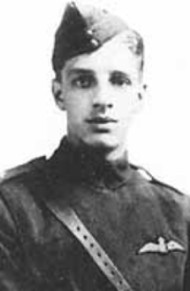
Cecil Arthur Lewis, from the interview, commenting on what he felt after November 11, 1918: “to find oneself alive, with the whole of life before one, and all the possibilities… it was an enormous release… and life just beginning with all that already behind…”
And what a life he led! Credited with shooting down eight German planes over Flanders and awarded the Military Cross, Lewis taught flying in China after the war, married the daughter of a White Russian general, and returned to England in 1922 and helped found the BBC. He wrote a number of successful books, one of which, Sagittarious Rising, about his Great War flying experiences, was recently recommended to me by a China’s Wings fan. As a screenwriter, Lewis won an Oscar in 1938 for his adaptation of George Bernard Shaw’s Pygmalion, and his screenplay served as the basis for the hit Broadway musical My Fair Lady.
Another fabulous China’s Wings inspired event just happened.
So this guy named Jeff Schader, who I don’t know, sees a China’s Wings post on my friend Jerry Heneghan’s Facebook page. (Jerry and I were company mates at West Point in the I-3 Polar Bears: Go Polar Bears.) Jeff Schader’s a photographically inclined guy. Here’s his website, with quite a number of fine images: My Life Through the Lens.
Anyway, Jeff visits this website, stumbles across the wonderful 1941 photo of Moon Chin on the China’s Wings page, and gets inspired to touch up the image. Quoting him from a FB post, “So I cleaned it up, got rid of the noise, dust, particles and properly blurred the background and fix the faded tone.”
I get a huge buzz when something I’ve written inspires someone to actually do something. Not just “like” it, but to do something, to take action.
Lately, I’ve been corresponding with Steve Marshall, who stumbled onto a copy of China’s Wings in a library a week ago Monday, read it cover-to-cover over the course of the next two and a half days, and was so inspired by the story of William and Kitsi Bond that yesterday afternoon, he decided to pay his respects in person…
The mortal remains of William Langhorne Bond and Katharine Dunlop Bond are in the cemetery in Warrenton, Virginia. Theirs is an incredible love story lived against some of the strongest headwinds of the 20th Century and they’re resting for eternity exactly where they should be–right next to each other.
Thanks to Steve Marshall making the effort to visit them and for forwarding the photo.
UPDATE: As he said he would, Steve went back today and took the Bonds a Christmas wreath:
I’m a lifelong fan of The Rolling Stones. Last year, I read Keith Richards autobio Lifeand particularly enjoyed the parts of it that described his creative process.
If you follow the link and listen to the various versions of the song, be sure to listen to the sound of the French police sirens, which brings it all together.
From The Sacramento Daily Union, January 11, 1868:
“POWER OF LOVE.- A young woman in San Francisco thought to test the sincerity of her many admirers by giving out that she had the small pox, and hanging a yellow flag from her house. She succeeded admirably, not one of her devotees coming near her.”
Sunday, December 7, 1941, “a date which will live in infamy…”
Actually, in Asia, on the other side of the International Date Line, it happened on Monday, December 8. This is the story of how the war came to Hong Kong and the China National Aviation Corporation (CNAC). Although, in truth, the war was pretty old news to everyone in CNAC in Decmeber of 1941– they’d been fighting it for four and a half years, ever since the Japanese invaded China in mid-1937:
DC-3, DC-2, and 2 Curtiss Condors at Kai Tak, 1941
Two of the airline’s three DC-2s gleamed on the packed dirt and stubbled grass in front of the the hangar at Hong Kong’s Kai Tak Airport. Alongside the DC-2s sat three Curtiss Condor biplane freight carriers. The previous night, the maintenance staff had fueled and serviced all five airplanes. Further down the flight line, three Eurasia planes waited in similar states of readiness – two tri-motored JU-52s and a much older single-engine machine. Pan Am’s S-42 Hong Kong Clipper floated on the placid waters of Kowloon Bay, tied against the flying boat pontoon.
T.T. Chen mixing a martini at Moon Chin’s house, 2004
A few minutes before 8:00 a.m., Chen Teh-tsan, T.T. Chen, a member of CNAC’s Hong Kong ground staff , was unloading the busload of Pan Am passengers he’d escorted to Kai Tak from the Peninsula Hotel, the sumptuous lobby of which the airlines used in lieu of a bona-fida passenger terminal. Suddenly, a noise. Everyone stopped. Airplane engines droned in the distance, growing louder.
“Look!” A passenger pointed to a gaggle of aircraft bearing down from the north at medium altitude.
“They’re British,” someone dismissed.
Chen had been in Chungking a few weeks before. He squinted at the formation. “No!” Those planes are Japanese!”
Pandemonium erupted. The passengers scattered. At a dead run, four of them followed Chen across the street and leapt into a dry drainage culvert with a bunch of blue-coveralled airport coolies. Maintenance Chief Soldinski sprinted to his car and raced for home. The crew of the Pan Am clipper took shelter in the sturdy dock house and yelled for Captain Ralph, who was still in the plane.
Kai Tak airport, pre-war, showing the main hangar and a flying boat tied up at the Pan Am pontoon. (Which looks to me like one of Pan Am’s three M-130s.) (Shirley Wilke Mosley collection)
The formation broke into parts and descended to attack altitude. Twelve single-engine Ki-36 bombers bent toward Kai Tak, escorted by nine single engine, fixed-undercarriage Nakajima Ki-27 “Nate” pursuit planes. With no RAF opposition aloft, the nimble pursuits peeled out of formation into line ahead and swooped to 50 feet, heading straight toward Pan Am’s flying boat like dragonflies skimming the surface of a pond.
Captain Ralph jumped through the Clipper’s door and sprinted down the dock. Bullets churned the water and chewed into the plane behind him. Too far to the dock house. The New Englander flung himself over the side into three feet of water and splashed behind a concrete piling. One behind the other, six Japanese pursuits riddled the Clipper and screamed overhead to attack targets farther down the field. Bullets from the seventh ignited a fuel tank. The huge flying boat whooshed into flame. Heat seared the dock. Captain Ralph cringed behind the pillar, unharmed.
Kai Tak airport nestled against the base of Kowloon Peak
The bombers cruised in level at 500 feet, their radial engine roar changing tone as they passed overhead. Black cylinders swished and fluttered earthward and boomed in rapid-fire succession among the parked airplanes. Hot shrapnel ripped bloated fuel tanks. Flaming geysers of aviation fuel gushed from torn fuselages. Massive secondary detonations annihilated the airplanes.
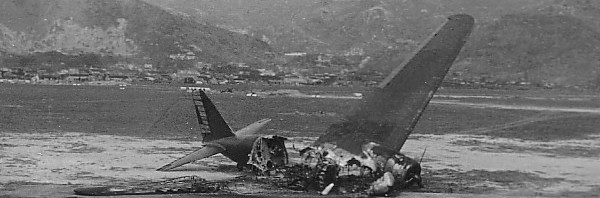
The attack ended as abruptly as it started. The Japanese droned into the distance and vanished about three minutes after they’d been sighted. In front of the hangar, the mangled remains of eight airplanes raged aflame under roiling palls of oily black smoke – three Curtiss Condors, the three Eurasia planes, and CNAC’s two DC-2s. Another greasy smudge jetted skyward from the ruins of the Pan Am clipper. The Royal Air Force’s contingent of pathetic biplanes – three Vildebeast torpedo bombers and two Walrus Amphibians – burned at the other end of the field.
One of the DC-2s destroyed by the attack
The Japanese attack on the China National Aviation Corporation at Kai Tak Airport and the airline’s aerial evacuations from Hong Kong is one of the best chapters in my book, China’s Wings.
In honor of Pearl Harbor Day, here’s a long-neglected story by Elizabeth McIntosh, a reporter for the Hololulu Star-Bulletin who covered the attack. It’s an excellent account written by a woman who was there.