 Lewis & Clark returned from their two-year trek to the Pacific Northwest in 1806. Four years later, in 1810, more than a hundred men set out to leverage their discoveries and establish a trading post at the mouth of the Columbia River, which forms the border between the modern states of Oregon and Washington. In those years, the most valuable natural resource in the North American interior was fur, and the Columbia drained the best fur country west of the continental divide. John Jacob Astor, kingpin of the American fur trade, financed the venture. In Astor’s vision, the outpost would dominate the fur trade of the Pacific Northwest, evolve into an American colony that would prevent the region falling under British or Russian sway, and anchor a phenomenally lucrative global triangle trade that linked the furs of the Pacific Northwest with the wealth of China, Europe, and the seventeen United States of America.
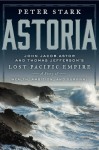
It was an ambitious undertaking with the potential to transform the destiny of the entire Pacific, and it’s the subject of Peter Stark’s fascinating new book Astoria: John Jacob Astor and Thomas Jefferson’s Lost Pacific Empire. Unfortunately, things did not go well. Before “Astoria”—as the outpost came to be known—ground to its abysmal end, Stark tells us that “sixty-one people had died in a gruesome spectrum of violent deaths.”
Astor’s concept earned the enthusiastic support of Thomas Jefferson, but at the helm of a trading and real estate empire centered in New York, Astor didn’t personally command the venture. The rotten leadership exercised by the men Astor chose to act in his stead doomed what might otherwise have grown into a wildly successful enterprise.
Astor’s grand adventure went west in two groups. One traveled overland, across the belt of the continent. The other party sailed around Cape Horn aboard the sailing vessel Tonquin.
Astor gave command of the Tonquin to Lieutenant Jonathan Thorn, a hero of the US Navy’s war with North Africa’s Barbary pirates. Thorn proved a poor choice. An arrogant and touchy martinet, Thorn couldn’t adapt his iron-fisted military leadership style to the more low-key manner required to gain and hold the respect of civilians. As Stark describes, Thorn’s personality combined “a rigid system of values and narrowly defined worldview” with “macho arrogance and a volatile temper”—a mixture “almost fated to go wrong.”
The Tonquin had hardly cleared New York harbor before Thorn earned the enmity of the trappers aboard who would establish Astor’s Columbia River colony. Six months later, in March 1811, after stops in the Falklands and Hawaii, Thorn’s poor judgment killed eight members of the ship’s company as they tried to find safe passage through the treacherous sandbar stretched across the Columbia’s mouth. And that summer, with Astor’s “emporium” established ashore, Thorn took the Tonquin to trade for sea otter furs with the Clayoquot Indians on Vancouver Island. Contemptuous and dismissive of the natives, Thorn offended a local chief, grossly mishandled a trading encounter, and was caught unawares when the Indians stormed his ship with stone clubs. The Clayoquot killed Thorn and most his crew. Four survivors held out below decks and escaped in a longboat that night. The next day, the tribe was looting the Tonquin’s cargo when the one mortally wounded white man left behind detonated 9,000-pounds of gunpowder in the ship’s magazine. As Stark describes: “The ship disappeared in a blinding flash and a billowing explosion of smoke. A thunderous roar rolled across the water, echoing for miles along the wooded coast. Torsos, limbs, heads, and pieces of flesh arced over the cove. Shattered bits of wood from the Tonquin’s thick hull and the cedar canoes rained down on the sea… Somewhere around two hundred Clayoquot perished… Body parts washed up on shore for days afterward.”
The tribe hunted down the Tonquin’s four escaped seamen and slowly tortured them to death.
The overland party came unglued in much less spectacular fashion. Whereas Captain Thorn ruled with too much iron, Wilson Hunt Price, who commanded the overland expedition, didn’t drive his people hard enough. Price dawdled his way across the continent, and Stark gives us excellent portraits of the flourishing native cultures Price passed through on his westering. The onset of winter caught Price’s party struggling to descend the treacherous canyons and rapids of the “Mad River,” as they called the Snake. Unable to force their way down Hell’s Canyon, Price and his fifty followers backtracked, ran out of food, and only survived with the aid of friendly Indians. Many died. The ragged survivors staggered into Astoria months overdue.
Conditions were better in Astoria, but not by much. Stark describes it as a “dank, dark setting, fringed by violent death,” and Price discovered the men who’d founded Astoria ahead of him leading an “anxious, paranoid, exposed life.” Instead of staying with the colony, which Astor had charged him to lead, Price opted to gallivant around the Pacific on a resupply vessel Astor had sent around Cape Horn to succor the colony. Far removed from the scene, Price was unable to influence Astoria’s fate. Those left behind mismanaged their relations with the native tribes. The outbreak of the War of 1812 between England and the United States, the possible treachery of one or more of the Scottish Canadian fur traders, and the wreck of a resupply vessel doomed the adventure. The miserable survivors sold out to the rival Canadian Northwest Fur Company for pennies on the dollar and tried to struggle home—a journey many didn’t survive.
The Astoria story was well known in Nineteenth Century America. Quite a number of survivors published accounts. John Jacob Astor himself commissioned Washington Irving, then one of the most famous American writers, to publish a book about the enterprise. The result was an 1836 bestseller. Through subsequent generations, the epic gradually slipped from the American consciousness. Peter Stark has done superb work resurrecting this fascinating story with the aid of journals, letters, articles, and survivors’ accounts, fleshing out his research with studies of Native American cultures and his own personal encounters with the relevant terrain. It’s an effective combination. Stark’s lucid prose moves quickly, in wonderful detail, as he unfolds Astoria’s gripping, tragic story on the canvass of a dangerous continent not yet brought to heel.