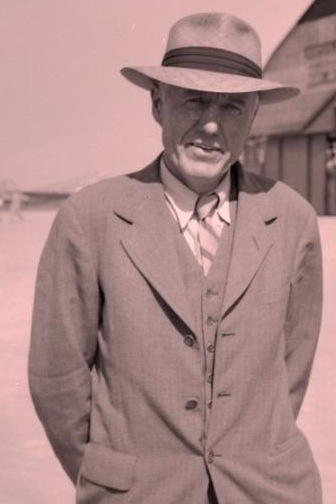
My son Ryan dressed as William Langhorne Bond for Historical Halloween


When the China’s Wings bound galley arrived in September, my son Ryan was so inspired that he decided on the spot to be William Langhorne Bond for his school’s “Historical Halloween” project. (I swear the idea came out of his head, 100%. In fact, I was so touched by his decision I damn-near cried.) He read China’s Wings and a few other sources, assembled a bibliography, and wrote a report.

Today is the big day, so here’s a picture of Ryan at school dressed as Bond, and I must say, Bond looked great among Jackie Robinson, Eleanor Roosevelt, Ghandi, Captain Cook, Abraham Lincoln, and many others. (Note Bond fiddling with his wedding ring.)

Share

CNAC photos — in color


I’ve been neglecting this blog lately due to revisions of an article about my adventures in Iran earlier this summer, a lot of home improvement projects (a new deck and an art studio for Tina), and some good surf, but Steve Michaels just emailed over some excellent photos his father took while he was flying for CNAC, a few of which are in color (scanned from color slides), and too good not to post. Here they come:

Loading cotton at Sian:

Transportation between town and the Kunming airport, late 1940s:

CNAC facility at Kunming airport:

C-46 with crew transportation at Kunming, late 1940s:

Loading cotton onto a C-46:

Share

Ernie Allison and O.C. Wilke


William Bond didn’t have any airline experience AT ALL when he arrived in China in 1931. None. Up to that point, he’d been a construction foreman. As such, he was very dependent on the professional aviators already engaged by the airline. The two most crucial were Ernie “Allie” Allison, his chief pilot, and his chief mechanic, O.C. Wilke.

I never had the opportunity to meet either man, but both of their daughters have been a tremendous help in the creation of China’s Wings.

Nancy Allison Wright with one of the first copies of her book, Yankee on the Yangtze

Allie’s daughter, Nancy Allison Wright (who was born during the airline’s darkest time in 1937), granted me unfettered access to the trove of her father’s CNAC-related letters and photographs, and through the years, we enjoyed much fruitful conversation and email correspondence. She was working on her own book about her father, and it has just been published.

I found Shirley Wilke Mosley, daughter of the chief mechanic, to be equally delightful, and as I explained earlier in this blog, a day I spent with her soon after I committed to this project really opened my eyes to the full glory of CNAC’s story before Pearl Harbor. Here’re the two links: something-more-substantial and the-most-exciting-undertaking. Seven-year old Shirley, wearing her prettiest flower print dress, makes a cameo appearance in China’s Wings, at the airline’s gala celebrating the arrival of its first DC-2 — she remembers being amazed that she could stand upright under the wing of an airplane so enormous.)

Ernie Allison (photo courtesy of Nancy Allison Wright)

Ernie Allison was one of aviation’s true pioneers. In 1931, he already had 14 years of flying experience and more than 8,000 hours of flight time. He’d been flying since 1917. He’d flown patrols along the Mexican border and instructed for the Army Flying Service during the World War and barnstormed around Philadelphia after demobilization. In 1920, he joined the United States Post Office’s fledgling airmail service, and Allison flew the airmail for seven years, pioneering air commerce and night flying alongside another young, then-obscure aviator named Charles Augustus Lindberg. Allison had been President of the American Pilot’s Association, and Lindberg was carrying a membership card signed by Allison when he flew the Atlantic in 1927. Allie and Bond were about the same age and height, but Allie was a much more powerfully built, formidable-looking man. Allie had a toothbrush mustache, a gruff bark, and although he was a pleasant, good-humored man away from the airport, on-duty, his pilots seldom saw him smile.

Bond quickly came to appreciate Allison one of the best, safest, most dependable aviators in the world.

Share

Evacuating wounded soldiers


Steve Michiels, son of CNAC captain Joe Michiels, made his first-ever appearance at a CNAC reunion last week, and he was kind enough to pass along scans of some of his father’s snapshots. I’m going to post a few.

CNAC C-46 aloft during the Chinese Civil War
CNAC C-46 evacuating wounded Nationalist soldiers – Pilot Joe Michiels standing in background
Loading wounded soldiers
Share

Bond’s background


William Langhorne Bond
William Langhorne Bond in the late 1940s

In 1918, William Langhorne Bond had shipped out to France as an enlisted man in the half-northern, half-southern Blue & Gray 29th Division. He returned in 1919 a commissioned officer, demobilized, and went back to work as a construction foreman for Langhorne & Langhorne construction, a heavy construction concern on his mother’s side of the family that built tunnels, roads, railroads, and bridges throughout the hills and coalfields of Appalachia. It was good, steady work, but by the middle 1920s, it had lost its appeal, and inspired by Lindbergh’s Atlantic crossing in 1927, Bond decided to seek out a job in what was the most exciting, cutting edge technology industry of the day – aviation.

Bond caught on with Curtiss Aeroplane and Motor Company in the summer of 1929, and a few weeks later, Curtiss merged with Wright Aeronautics and Keystone Aircraft, giving Bond a job in what had become America’s largest aviation company. Bond built a factory for Curtiss-Wright outside Baltimore, but the stock market crash and recession that dogged  the U.S. economy in 1929-1930 hit Curtiss-Wright particularly hard and the factory sat idle. Well aware that no job could be more insecure than that of a man in charge of an idle factory, in early 1931, Bond accepted Curtiss-Wright’s invitation to go to China and serve as the Operations Manager of the China National Aviation Corporation, a then-foundering airline that Curtiss-Wright had formed in 1929 in partnership with China’s fledgling Nationalist Government.

An extraordinarily hardworking, dedicated, loyal man, William Langhorne Bond would remain an integral part of the airline’s leadership until its 1949 demise.

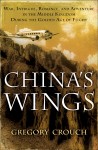
He’s the main character in my book, China’s Wings.

China's Wings

Share

A Major Mistake


When I’d finally done enough background reading, primary source research, interviewing, and thinking about the CNAC story of the 1930s and had definitely decided that part of the airline’s story merited much more substantial treatment than I’d originally envisioned (a process which took about 18 months), I decided to try and tell William Bond’s and Moon Chin’s stories together, imagining a parallel biography with Bond’s point of view carrying the larger “strategic” story of the airline and Moon’s painting a picture of what it was like to fly in China in the 1930s and 40s.

It proved a major mistake. I ended up with a colossally long manuscript, whose pace dragged as the narrative bounced back and forth between the two men. There were too many transitions, and the story was too slow.  It wasn’t as exciting as I knew it should be. And HAD to be, if the book were to be a success. Moon’s anecdotes, and the anecdotes of many of the other characters in the CNAC universe (men like Ernie Allison, Chuck Sharp, Hugh Woods, Chilie Vaughn, and Bill MacDonald, whom I’ll introduce in coming weeks), while fascinating and exciting, didn’t move the story forward fast enough. They sapped China’s Wings narrative drive. I had to commit to one main character, and however much I’d fallen in love with Moon Chin and his amazing life, the needs of the narrative required that man to be William Bond.

In retrospect, I should have recognized much earlier in the writing process that I was having to work too hard to fit it all together.

However, I felt compelled to see everything “whole” before I could decide what to cut, and so I wrote out every conceivable anecdote and wove them into a very awkward narrative. I knew I was going on too long, I just couldn’t bear to omit things until I’d seen it complete. Looking back, I’m glad that I made that effort, because it gave me confidence in the trimming decisions I’ve made, but that original manuscript was probably 100,000 words too long, and probably cost me close to TWO YEARS of extra work.

China’s Wings final manuscript cleaves to William Bond’s point of view, he’s definitely the book’s main character. I’ve included stories from the supporting players only when they intersect the overarching narrative. And making those cuts was some of the hardest literary work I’ve ever done, because I truly love the excised stories. Taken as isolated pieces, they’re some of the best writing I’ve ever done, and I suspect most of them will find their way into this website in the coming months. Moon Chin’s stories that I’ve chosen to keep – principally his epic and courageous roles in the evacuations of Hankow (October, 1938) and Hong Kong (December, 1941) – are places where his experiences propel the airline’s larger drama.

And they’re two of my favorite stories in the whole book.

Share

William Langhorne Bond


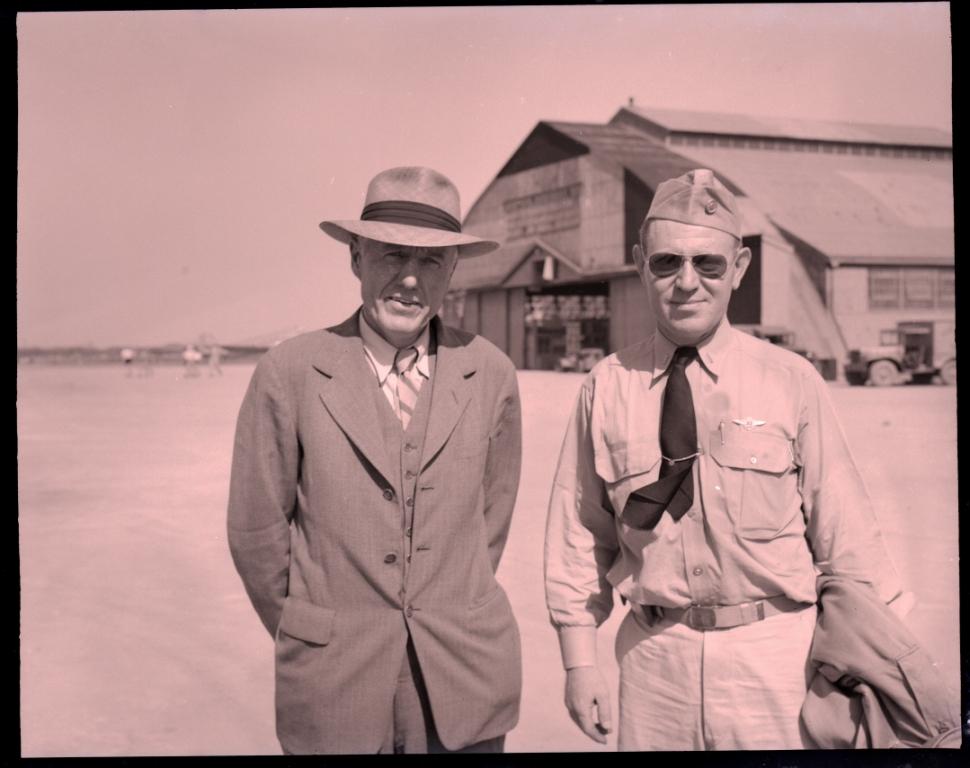
On the left, William Langhorne Bond

For all that I’ve written about Moon Chin since I started this China’s Wings website last year, he’s not my main character. That distinction goes to William Langhorne Bond.

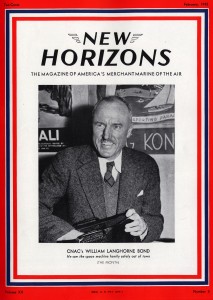
William Bond - NewHorFeb1942 copyLike Moon, Bond was truly a remarkable man, and although I never had the opportunity to meet him (he died on July 17, 1985, when I was just starting my second year at West Point), he left behind a large collection of letters, interviews, and the handwritten manuscript of a book. Bond’s letters are especially good, for he wrote with clarity and elan, often in exquisite detail, recounting stories, jokes, and pithy asides, and his correspondence with Harold Bixby and Stokely Morgan at Pan Am headquarters in the Chrysler Building and with his wife Kitsi, who was often in Washington, DC, provided the lion’s share of the source material from which I reconstructed his incredible story.

A 37-year old former heavy construction foreman from Petersburg, Virginia, William Langhorne Bond arrived in China on March 17, 1931, Saint Patrick’s Day, to take a job as the Operations Manager of the China National Aviation Corporation. He didn’t know it, not then, but CNAC and the Middle Kingdom would dominate the next twenty years of his life.

Click here for more of Bond’s backstory.

William Langhorne Bond at Shanghai’s Lunghwa Airport, probably 1936
Share

Four DC-2s on the Lunghwa flightline, 1937


Here are CNAC’s four DC-2s on the Lunghwa flightline in 1937, before the Marco Polo Bridge incident, the Japanese invasion, and the Battle of Shanghai.

These were four remarkable airplanes, and they gave the airline many thousands of hours of productive flight time. One of them became the first civilian airliner ever shot down by hostile air action when it was attacked by the Japanese after leaving Hong Kong in August, 1938… salvaged, repaired, renamed, renumbered, and reinstalled in service, it would get shot down and totally destroyed by the Japanese for a second time in October, 1940. Two of them were bombed to death in the Japanese air raid on Hong Kong’s Kai Tak airport on the morning of December 8, 1941 (Pearl Harbor Day west of the international dateline), and the last one  crashed and burned while trying to take off from Kunming in March, 1942.

Four DC-2s at Shanghai 1937 (Courtesy of Tom Moore at cnac.org)

Moon Chin was the copilot of CNAC’s first DC-2 crew, for DC-2 number 24, when it debuted for the airline in the spring of 1935, and he would fly it regularly until December 8, 1941, when he watched it get blown out of existence from his bedroom window.

Tom Moore of cnac.org is the nephew of pilot Emil Scott, who was killed in the March 1942 crash of CNAC’s last DC-2. Here’s the link to Scotty’s page at cnac.org.

China’s Wings: War, Intrigue, Romance and Adventure in the Middle Kingdom During the Golden Age of Flight.

Share