Moon Chin’s first air raid, part I


This is the second part of this story, one of China’s Wings outtakes, describing what happened to the various CNAC pilots during the dark days of August, 1937, when a colossal battle between Japan and China erupted in Shanghai. Here is it’s beginning.

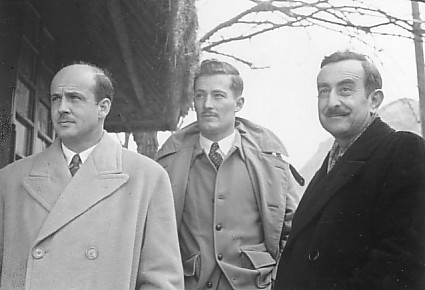
Moon Chin in the middle, Donald Wong on the right. (And Joy Thom in the middle.) In front of a Stinson Detroiter

During the night of Sunday, August 15, heavy wind and rain swept in from the China Sea and battered Shanghai.[i] The weather wasn’t so bad in Nanking, 180 miles inland. The city’s thick Ming Dynasty walls were thirty-miles in circumference, and they contained two airports, one civilian and one military.[ii] CNAC pilots Moon Chin, Donald Wong, Hal Sweet, and Bob Pottschmidt had spent the night in Nanking. Just as they sat down to the Metropolitan Hotel’s breakfast, airline operations summoned them to the commercial airport. All four hurried to the flight line without eating and were told to take off, right away, and follow Donald Wong’s Ford tri-motor to Hankow. The Ford was the only plane with a radio, and since the Stinsons couldn’t keep pace, Wong flew ahead and circled while the others caught up, and thus the formation inch-wormed west, up the Yangtze. Halfway to Hankow, the Ford U-turned and flew back east. Sweet, Pottschmidt, and Moon Chin assumed Wong had received new instructions. They dutifully followed in their little monoplanes, and Wong led them all the way back to Nanking.[iii]

Stinson Detroiter

Nobody in Nanking had any idea why they’d been recalled.[1] The hungry pilots left their planes with the ground crew and hustled back to the hotel to gobble lunch while the planes were serviced — every one of them had missed breakfast. Moon Chin pinched up a few morsels between the tips of his chopsticks. Two or three bites into his meal the air raid sirens wailed.[iv] The telephone rang and summoned the pilots back to the airfield with orders to get their airplanes away before the raid arrived. Moon Chin wolfed a few more bites and dashed after the others.

Ford Trimotor in Yunnan Province

Donald Wong’s “Tin Goose” tri-motored Ford and Hal Sweet’s Stinson were fueled. The two of them took off for Hankow. Bob Pottschmidt, a lean, blonde, twenty-six year old former track star from Winthrow High School in Cincinnati, Ohio,[v] was perched atop the wing of his Stinson, helping a coolie fuel the plane. “Potty” held a chamois across the mouth of a funnel with one hand and the fuel hose with the other. Below him, the blue-dungareed coolie frantically worked a hand pump threaded into the top of a 55-gallon fuel drum. Moon stood beside the tail, waiting his airplane’s turn. Soft drizzle leaked from gunmetal gray clouds, ceiling 500-feet.

Moon Chin heard a far-off rumble. Pottschmidt heard it, too: the drone of airplane radials. Three blurs appeared in the scrappy mists trailing from the cloud bottoms. The planes lost a few more feet of altitude and resolved into twin-engine monoplanes. “Those’re Jap bombers!” yelled Potty. “They’re gonna hit the other field!”[vi]

The flight dropped out of the clouds on perfect course to attack the flight line of the military airfield, about a mile from where the CNAC men serviced their planes. Black clouds of debris spat up from the earth. The roof of an immense hanger leapt into the air atop a yellow-red pillar of flame.[vii] Torrents of anti-aircraft fire reached for the attacking planes. Moon Chin hadn’t seen bombs fall. A second later he heard the booming detonations.

Pottschmidt dropped the hose and leapt off the wing. Moon joined him in a sprint for the airport gate. The coolie kept pumping like mad. He was staring at the bombing and hadn’t noticed Potty’s jump. Gas squirted onto the ground and pooled around his feet before he yelped and ran after the others. The airport guards refused to let them leave. More bombs exploded on the nearby airfield. Moon and Pottschmidt ran to the passenger terminal, a solid construction. It was packed with frightened civilians. The Generalissimo’s personal hangar was beside the terminal. The two pilots ran to a concrete bench opposite and wriggled to shelter on the muddy ground beneath.

Other bombers dropped out of the cloud layer, every one perfectly lined up to pummel the military airfield. “That’s some damn fine navigation,” observed Pottschmidt.

“They’re getting help,” Moon stated.

Pottschmidt nodded. It couldn’t be done any other way. The Japanese had to be getting help from fifth columnists on the ground in Nanking. Flying from bases on the island of Formosa, far to the south, the bombers were probably homing in on the Nanking Radio Station, mouthpiece of the Kuomintang, which pushed the strongest signal in the city. It wasn’t Nanking Radio, however, that betrayed the presence of local assistance. The perfect short-range approach did that. Radio Nanking’s signal would get the bombers into the city’s vicinity. It wouldn’t get them to points of such phenomenal precision over the airfield. To do that, someone on the ground must have placed smaller transmitting beacons a mile or two on either side of the airfield, the exact axis of approach the bombers intended to use being the line drawn between the two transmitters. Close to Nanking, the bombers tuned their homing devices to the short-range beacons, then maneuvered until they had the two signals exactly aligned. Keeping the signals together, the planes flew towards them at a pre-planned altitude. The instant they passed over the first beacon (they’d know it had occurred when that signal’s direction flipped 180 degrees), they began their letdown through the clouds at a predetermined descent rate, continuing toward the second transmitter and therefore perfectly lined up with the target. They popped through the clouds at five or six hundred feet, in the middle of their bomb runs, just like they’d been making a foul weather instrument approach to the airfield, which was, of course, exactly what they had been doing. It was a very avant-garde aviation technique for 1937. There was no other possibility.[viii]

Suddenly, a Japanese bomber peeled from formation and banked in their direction.

Here’s this story’s conclusion…


[i] Sunday’s weather: “Chinese Surprised,” New York Times, August 16, 1937.

[ii] Nanking’s Ming Dynasty walls contained two airports: Bixby, Harold M., Topside Rickshaw, Ch. X, pp. 58; Author interview with Moon Chin, September 17, 2004.

[iii] August 15 details and the Nanking air raid: author interviews with Moon Chin, September 17, 2004 and January 7, 2005; “Bob Pottschmidt,” a summary of his personal history written in the late 1980s and posted at cnac.org

[iv] “Chinese Fight Foe in the Air at Nanking; Report Downing 6 of 12 Attackers,” New York Times, August 16, 1937: “Japan’s first air attack on Nanking yesterday [August 15] undoubtedly as the highpoint of the day’s aviation activity.”; Chang, Iris, The Rape of Nanking, pp. 65; Imperial Japanese Navy Lieutenant Commander Hiramoto, Michitaka, “Air Raid on Nanking,” The Chinese Mercury, Winter 1938, confirms Moon Chin’s recollection that August 15, 1937 was the date of the first Japanese air attack on Nanking.

[v] a twenty-six year old former track star from Cincinnati, Ohio’s Winthrow High School: unidentified newspaper clipping posted at cnac.org.

[vi] Pottschmidt’s quote: author’s interview with Moon Chin, September 17, 2004 and January 7, 2005.

[vii] Hanger detonation: Lieutenant Commander Hiramoto, Michitaka, “Air Raid on Nanking,” The Chinese Mercury, Winter, 1938.

[viii] Details of this day: Author’s interview with Moon Chin, September 17, 2004, January 7, 2005; “Bob Pottschmidt,” C.N.A.C. Cannonball, January 15, 1989; Michitaka Hiramoto’s article “Air Raid on Nanking” confirms the poor weather (“a raging typhoon” and “the city lay under heavily banked clouds”) and that much planning went into the execution of this raid: “All the details of the expedition had been gone over carefully”; Moon Chin carefully described the precise Japanese navigation and its requirement for covert support to the author on multiple occasions.

Share

China’s Wings reviewed in World War II magazine


I’m pleased! I’ve been worried about the reception China’s Wings might get from the academic world, and I’m very gratified to get such a glowing review from a professional historian.

In the July/August, 2012 issue of World War II magazine, aviation historian Richard R. Muller reviewed China’s Wings as “a first-rate saga of aviation, wartime politics, and business that manages to be gripping without sacrificing scholarly rigor,” a “compelling narrative,” and “an exceedingly appealing combination of adventure story, aviation and military history, and earthy travelogue.”


Share

Evacuating Shanghai, August 1937


To maintain narrative momentum and keep focused on the story’s main character, William Langhorn Bond, I excised most of the details of CNAC’s evacuation of Shanghai from China’s Wings chapter 8, “Things Fall Apart,” which happens in mid-August, 1937 at the beginning of the Battle of Shanghai.

A couple of really amazing and adventurous anecdotes were contained within, however — particularly the ones based one my interviews of Moon Chin and the diary entries and correspondence given to me by Nancy Allison Wright, Ernie Allison’s daughter — and I’m going to work them into my next few China’s Wings posts here on my website.

Chapei on fire north of the International Settlement, August 1937

We begin at Shanghai’s Lunghwa Airport on August 15, 1937, with Shanghai erupting into flames north of Soochow Creek, some 6 or 8 miles north of the airport, as fighting broke out between Japanese and Chinese forces.

One of CNAC’s Stinson Detroiters

American Royal Leonard, the Generalissimo’s personal pilot, flew one of CNAC’s DC-2s from Shanghai to Hankow for $1,000 Chinese dollars. Frank Havelick took another. Floyd Nelson flew the third under protest.[i] He’d flown 260 hours in the last two months and was sick from exhaustion. CNAC operations called Moon Chin and ordered him to the airport. Moon left his wife in their French Concession apartment. Allison’s evacuation was underway when he reached Lunghwa. Donald Wong, Moon’s best friend, was outbound for Nanking in one of the airline’s two Ford tri-motors. Hal Sweet and Bob Pottschmidt each had a Stinson in the air behind Wong. Allison assigned Moon Chin to follow in a third Stinson.[ii]

Street fighting in Shanghai

Moon winged up from Lunghwa and raced west, away from the city. Behind him, downtown, he glimpsed the Japanese warships clogging the Whangpoo’s Pootung bend and the whiffs of smoke wind-blown from the muzzles of their guns as they belched cannon fire point-blank into the fighting. Brutal, awful, close-quarters melees raged in the dense neighborhoods north of the International Settlement. Driven by the strong winds, smoke whipped sideways from battlefield infernos in Chapei, Hongkew, and Yangtzepoo. Japanese war planes swooped and dove over targets around North Station.

Warships in the Whangpoo

West of the city, Moon Chin arced northwestward and set course for Nanking. He had no idea when, how, or if he’d be able to return to Shanghai. He hoped his wife would be safe behind him. Moon cruised toward China’s capital at 125 miles per hour with his wings skimming the base of the cloud layer, quick shelter should he encounter Japanese planes. Moon Chin found two of the company’s Stinsons and the Ford tri-motor on the ground ahead of him in Nanking. He joined the other pilots at the Metropolitan Hotel and awaited instructions.[iv]

Here are forty pictures taken during the Shanghai fighting.

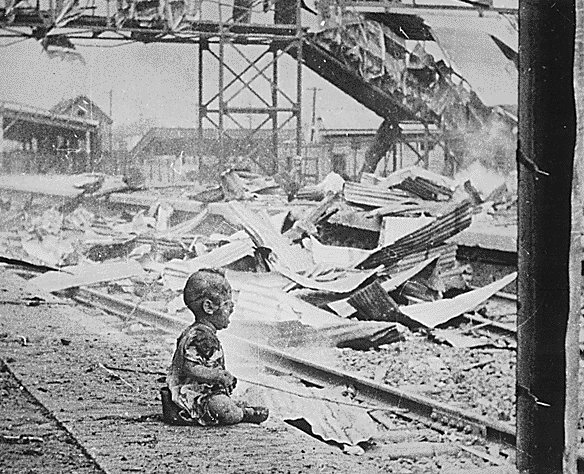
Famous photo of a baby in a Shanghai railroad station at the beginning of the battle

Here is the continuation of this story: Moon Chin’s First Air Raid, Part I.


[i] Leonard, Havelick, and Nelson flew DC-2s from Lunghwa to Hankow: Manila Bulletin, August 29, 1937, clipping provided to the author via email by Ernie Allison’s daughter, Nancy Allison Wright, November, 2005.

[ii] Moon Chin’s experience evacuating Shanghai: author’s interviews with Moon Chin, September 17, 2004, January 7, 2005, April 19, 2006.

[iii] Ground combat: New York Times, August 15, 1937.

[iv] Moon Chin’s flight from Shanghai on August 14: author’s interviews with Moon Chin, September 17, 2004; January 7, 2005; April 19, 2006; “Bob Pottschmidt,” a summary of his personal history written in the late 1980s posted online at cnac.org (I suspect Pottschmidt runs two days together into one. The air raid Potty describes in Nanking occurred on August 15.)

Share

“Goddamn it, I promised the wife I wouldn’t do this any more.”


Eu Gardens, Hong Kong, 1938

Here’s another favorite outtake from my book China’s Wings:

Few people in the Hong Kong Colony had larger disposable incomes than CNAC’s Caucasian pilots, and few had more “face” in both Western and Chinese communities. They were admired by all strata of Hong Kong society, although perhaps not so much liked by the upper crust British as tolerated with a grudging nod to their courage and competence and in recognition of the valuable service they provided. Most of the Caucasian pilots lived Kowloon-side in the “Eu Gardens” at 158 Argyle Street, modern apartments reminiscent of those found in Southern California and built to the maximum residential height allowed in Kowloon – thirty-two feet.

Sylvia Wylie and Chuck Sharp in 1938

In lieu of gibbons, Chuck Sharp satisfied his pet-owning urge by acquiring a pair of dachshunds. He had a serious girlfriend, Sylvia Wylie. He bought a sail boat, and he and his pals spent off-duty days skimming the aquamarine waters of Hong Kong and exploring the bays and inlets of the surrounding islands. They ate elaborate lunches packed by their serving staffs and swam with their wives and girlfriends at an isolated beach seven miles from Kowloon where the pilots rented a weekend bungalow. Robert Pottschmidt was an avid amateur photographer who captured images of shirtless men leaning against the rail and propping their feet on the hatchways of Sharp’s sailboat and smiling at happy looking women in bathing costumes and holding drinks. Off-duty, the men sailed, shot birds, indulged hobbies, and played baseball and tennis, but their talk always drifted back to airplanes. Their wives played bridge and mah-jongg, gave each other fancy tiffins, teas, and garden parties and poured over the latest fashion news from New York. They shopped in the Colony’s smartest shops and wore sundresses and fancy hats to high tea in the sumptuous lobby of the Peninsula Hotel. The men wore tropical whites in hot weather and shirt sleeves and open collars for sport, but more often than not, they buttoned their shirts and wore gray or pinstriped suits, waistcoats, pocket watches, and silk ties, which they seldom loosened, even at informal parties held among themselves. In the years between the Battle of Shanghai and Pearl Harbor, Hong Kong was a wonderful place for westerners with money.

Chungking in 1938

Diversions weren’t so lively when the pilots overnighted in Chungking. None of Shanghai’s frenzied glamour had migrated upriver to the wartime capital. It was phenomenally dull. Whenever they could, the Caucasian pilots stayed in the Standard Oil Company compound on the South Bank, across from the city, but Socony’s rooms often filled with other itinerant visitors, which relegated the CNAC overflow to a grimy, rat-infested three-story hotel called the Shu Teh Gunza. Forced into residence, the men enlivened the dark, dull, interminable Shu Teh Gunza evenings with games of poker, craps, and bridge. Gambling didn’t always suffice. The men obtained variety by poking their head out of the establishment’s door and yelling for Joe, the Number One houseboy. Invariably, they ordered him to summon girls.

Happily, the Shu The Gunza was located adjacent to a whorehouse, and it was a chicken or the egg conundrum as to who had arrived first, the pilots or the prostitutes. Houseboy Joe never needed more than a few minutes to appear with five or ten peasant girls in tow. Joe ordered the girls to disrobe. Coarse vestments fell to the floor and the players looked up from their cards and watched the naked girls march a few circuits of the room. The girls were worn and unattractive, and after a few minutes of parade the pilots usually informed Houseboy Joe that none were acceptable. The pilots passed the hat for tattered bills and old coins, and each girl received one Chinese dollar, then worth about one American nickel at open market exchange rates. Houseboy Joe rushed off to summon a replacement phalanx. Pilot Hugh Woods never detected repetition, but he suspected that most were simply local  women herded together by the promise of an effortless dollar. It being China, however, more extensive services were available, and the boys could buy them for pocket change. Mortal terror of the unkillable venereal diseases reputed to inhabit Chinese prostitutes kept Woody from motivating himself to action, but some of his comrades were much less discriminating.

“Goddamnit,” lamented one of Woody’s married peers as he pushed up from the card table one glum, lonely Chungking evening and gestured a girl toward an upstairs bedroom, “I promised the wife I wouldn’t do this anymore.”


[i] CNAC’s valuable service: Arthur N. Young to H.H. Kung, March 1, 1940, the Young Papers.

[ii] Eu Gardens: Gellhorn, Martha, “Flight into Peril,” Collier’s, May 31, 1941.

[iii] Life in Hong Kong; CNAC fashion observations: Photos of the Hong Kong years provided to the author by Shirley Wilke Mosley, daughter of CNAC chief mechanic Oscar C. Wilke, Nancy Allison Wright, daughter of Ernest Allison; photos in the Bond Papers and in Wings for an Embattled China; Hahn, Emily, China to Me, pp. 113-116; Woods, Hugh, “Pre-War Life in Shanghai and Hong Kong,” Wings Over Asia: Memories of CNAC, Volume IV, pp. 4-9, 27-33, 40-46; Gellhorn, Martha, “Flight into Peril,” Collier’s, May 31, 1941; Angle, Chrystal, Reflections of Chrystal, pp. 173-178.

[iv] Diversions at the Shu Teh Gunza hotel: Woods, Hugh, “Playtime in Chungking,” Wings Over Asia: Memories of CNAC, Volume IV, pp. 25-26.

Share

“All right… but Mickey, why a limey?”


Hal Sweet on the left. (With Sidney De Kantzow and Pop Kessler)

The last of the Emily “Mickey” Hahn outtakes from China’s Wings that I’ve been posting for the last week or so… (Start here and work your way forward.)

Like many of the CNAC pilots, Hal Sweet was friendly with Mickey Hahn. She and Charles Boxer had decided to get pregnant, and they’d succeeded, even though they weren’t married. Her and Charles Boxer hadn’t made any announcement, but the the whole world must have noticed, because in the summer of 1941, Mickey’s condition was obvious. However, nobody had the gumption to mention the situation to her face.

Society’s tight lips became a joke between her and Charles Boxer. They decided to award a prize to the first person to mention the pregnancy – a box of chocolates if it was a woman, a box of cigars if male.

Mickey Hahn and Mr. Mills

Hal Sweet bumped into Mickey Hahn in a shop after the DC 2 ½ episode. He hemmed and hawed and invited her for a drink. She accepted.

Sweet cleared his throat a few times once they were seated.

“Ah… Mickey… have you been married lately?”

She explained to him that he’d just won a box of cigars.

Hal Sweet frowned at her swelling tummy, “All right… but Mickey, why a limey?”


Hal Sweet and the cigars: “All right, but Mickey, why a limey?”: Hahn, Emily, China to Me, pp. 255; Cuthbertson, Ken, Nobody Said Not to Go, pp. 214, citing a personal interview with Emily Hahn.

Share

Ernest Hemingway and China’s Wings


As noted in yesterday’s “Boxer Uprising” post featuring Mickey Hahn, Hugh Woods, and Ernest Hemingway, Ernest Hemingway spent time with CNAC in late 1940 and early 1941, and he was so impressed with what the airline accomplished that he gave the CNAC pilots a plug in his posthumous novel, Islands in the Stream, pp. 289, when the book’s main character, Thomas Hudson, is musing about the time he’d spent in Asia with “Hong Kong millionaires,” including “about six pilots for the Chinese National Aviation Company [sic], who were making fabulous money and earning all of it and more.”


I couldn’t fit the Hemingway anecdotes into China’s Wings, but it’s great to know that Ernest Hemingway admired the CNAC pilots as much as I do. My best guess as to the six pilots Hemingway was referring to is Hugh Woods, Chuck Sharp, Hal Sweet, Bob Pottschmidt, Billy MacDonald, and Frank Higgs.

And here’s “All Right, Mickey, but why a Limey?


Share

Emily Hahn, Martha Gellhorn, Ernest Hemingway, China’s Wings, and The Boxer Uprising


2011 05 17 cover mock up v2I found a few more Mikey Hahn-flavored outtakes from the China’s Wings rough draft to add to the three-part story I told this week. Here’s one of them, which probably took place in late February or early March, 1941. (Hat tip to Eric Mueller, see his comment below):

Emily “Mickey” Hahn didn’t return to the United States from Hong Kong. She stayed in the Colony and fell into a none-too clandestine affair with married British Army officer Charles Ralph Boxer. He worked in intelligence, and duty often called him to long hours. In her alone time, Mickey became friendly with CNAC’s Caucasian personnel and their wives, although as a writer without a financially successful book, she couldn’t keep the fast, fashionable pace maintained by the CNAC wives and girlfriends in anything except scandal, a Hong Kong niche she’d quite well cornered.

Martha Gellhorn and Ernest Hemingway, 1941

Other international notables fell into the extended social circle, including Martha Gellhorn, a groundbreaking female war correspondent who’d made her reputation reporting for Collier’s from the hottest combats of the Spanish Civil War and was a close personal friend of First Lady Eleanor Roosevelt. Gellhorn had come to the Orient to write about the China war, and her nose for a good story led her straight to the China National Aviation Corporation (CNAC). A gorgeous, long-legged blonde, Gellhorn had a new husband in tow, her second, and he was a renowned writer in his own right — Ernest Hemingway. Gellhorn, in turn, was Hemingway’s third wife, and he was basking in the smashingly successful release of For Whom the Bell Tolls, his novel of the Spanish Civil War. Gellhorn researched the airline; Hemingway pitched camp in “The Grips,” as the lobby bar of the Hong Kong Hotel was known throughout the Colony, and fell in tight with a crowd off-duty CNAC pilots and staff who often rendezvoused there after work to swill gimlets and exchange stories. One such gathering was picking up steam when a pilot noted Mickey Hahn’s absence. Hugh Woods wondered where she might be.

“She’s probably putting down a Boxer uprising,” retorted Hemingway.

The assembled fuelers erupted with laughter, and Woody could hardly wait to report the quip to the lady herself.

When he did, Mickey drew herself straight and peered at the cheeky pilot with regal Cleopatran scorn. “No one need have been concerned,” she pronounced. “You can assure Ernest that I had the situation well in hand.”

Although perhaps disappointed that such a scandalously delightful woman hadn’t fallen for one of the available aviators in their own crowd, the pilots took a measure of American pride in the fact that Mickey had poached the amorous attentions of a man who was clearly one of the more capable and intelligent officers in the British community. Mickey’s affair fared considerably more poorly in British circles, still stung by memories of King Edward the VIII’s abdication of the throne to marry “that dreadful woman,” American double divorcee Wallis Simpson.

*     *     *

Next, I’ll post the compliment Hemingway paid to the CNAC pilots in his posthumous novel, Islands in the Stream.


Here’s a nice piece about Gellhorn in The Atlantic.

*     *     *

Hemingway and Gellhorn left the US in January, 1941, arrived in Hong Kong on February 22, and flew into the Chinese interior aboard one of CNAC’s Curtiss Condor freight planes on March 24: Moreira, Peter, Heminway on the China Front: his WWII Spy Mission with Martha Gellhorn, pp. 13-70; Lyttle, Richard B., Ernest Hemingway: The Life and the Legend, pp. 136-138; Bond, William L., Wings for an Embattled China, pp. 237-238. [Bond misplaces his Hemingway anecdotes in Wings. In Hong Kong, Gellhorn and Hemingway lived in the room at the Repulse Bay Hotel that had been vacated by Bond’s son, Langhorne and his nurse, Olga Chen.]

“The gimlet is the tipple of Hong Kong”: Hahn, Emily, China to Me, pp. 91.

The Boxer uprising: Woods, Hugh, “The Boxer Rebellion,” Wings Over Asia: Memories of CNAC, Volume IV, pp. 30

A tone of fondness and approval colors CNAC’s memories of Mickey Hahn: Hugh Woods’s anecdotes in Wings Over Asia: Memories of CNAC, Volume IV; and in the cameo appearances she makes in Bond, William L., Wings for an Embattled China; author’s interview with Moon Chin, Frieda Chen and T.T. Chen, September 18, 2006.

That Mickey Hahn’s affair with Charles Boxer fared poorly in British circles, stung by Edward the VIII’s abdication: Cuthbertson, Ken, Nobody Said Not to Go, pp. 205.

Share

Emily Hahn and CNAC, aka The Hardest Cut, Part III


This is the third part of this story, and they ought to be read in order. Here’s Part I and Part II.

The putrid ape smell didn’t fade from the apartment for weeks. Long before that happened, Woody learned Mickey Hahn was carrying on with Charles Boxer, a married major in the British Army. Woody had the good sense not to play the jilted fool. He and Mickey stayed friends, and Woody indeed felt guilty about reneging on his commitment to her pets. He retrieved them from the SPCA one Sunday afternoon and took them to Kai Tak airport for a change of scenery. A handful of airline employees were prowling around in the back of the hanger, where the British airport administration kept a full-service bar. Woody took a cocktail to a table with a few associates and anchored the apes to the leg of his chair with ten-foot chains. Sounds of American merriment attracted the airport manager, Mr. A. J. R. Moss, a lanky, angular Englishman wearing loose tropical shorts, a well-starched shirt, and high-pulled socks. The Americans thought him the prototypical British colonial officer, not a bad sort, just inefficient and officious. Moss inquired about the gibbons.

Woods assured the Englishman he had the animals under control. Moss nodded and sidled to the table edge, tucked a swagger stick under his arm, and chatted with the seated Americans. Nobody noticed Mr. Mills, the larger of the gibbons, sneak behind Moss and peer up the Englishman’s shorts. Something he saw aroused his curiosity, and Mr. Mills reached a thin, hairy arm up Moss’ pant leg and wrapped his knotty fingers around the most prominent of the visible objects.

Moss howled. He would have leapt five feet in the air if the gibbon’s vice-like grip hadn’t anchored him so firmly to the ground. Woods and the other Americans hurtled off their seats, startled by the blood-curdling yell. Woody’s leap knocked over his chair, and the apes’ chains came free. The animals fled up the hanger girders and sheltered on the crossbeams under the rooftop, each terrified animal dangling a ten-foot chain. The Americans flopped around on the hanger floor, paralyzed with mirth and Moss’ pained embarrassment, eventually bestirring themselves to recapture the gibbons.

Woody never again dared take them out in public.

Mr. Mills was an older gibbon. He died sometime later, apparently due to complications caused by large open sores festering around his private parts. Mickey Hahn told Woody that although she couldn’t offer a professional medical opinion, she was convinced he’d died of syphilis.

And here’s “Emily Hahn, Martha Gellhorn, Ernest Hemingway, China’s Wings, and the Boxer Uprising…


Emily Hahn description: Hahn, Emily, China to Me; Ibid., No Hurry to Get Home; Cuthbertson, Ken, Nobody Said Not to Go, (a biography of Emily Hahn); Angell, Roger, “Postscript: Ms. Ulysses: Emily Hahn’s lifetime of reporting and vivid adventure kept her happily out of touch with convention,” The New Yorker, March 10, 1997;

Mickey Hahn, Hugh Woods, Chuck Sharp, and the gibbons: Woods, Hugh, “Gibbons,” Wings Over Asia: Memories of CNAC, Vol. IV, pp. 31-33; Hahn, Emily, China to Me, pp. 153-154, 205, 210, 235-237, (“noisily airsick”; “commenting on the shakiness of the plane”) It’s trivial, and in no way undermines the essential truth of her account, but in Emily Hahn’s China to Me, she flew from Chungking to Hong Kong on a CNAC flight piloted by Hugh Woods and with “the manager” (Bond) in the passenger cabin in late February, 1940 [using Cuthbertson, Ken, Nobody Said Not to Go, pp. 177-207, to help pinpoint the dates]. That is unlikely: both Bond and Woods were in the United States in February, 1940. After a brief Hong Kong sojourn, Hahn returned to Chungking and spent the bombing season in the wartime capital. She finished her Soong Sisters manuscript in July and again flew back to Hong Kong. Both Woody and Bond were in the Orient in the summer of 1940. I suspect Emily Hahn misordered her episodes with Woody, CNAC, and the gibbons when she wrote China to Me from the vantage of 1944, and that the February flight she described as making with Hugh Woods actually occurred in July. That timeline also puts the event into accord with Woody’s “Gibbons” anecdote in Wings Over Asia: Memories of CNAC, Vol IV. Woods was in the Orient in July, again flying for CNAC, and according to Woody’s account of his flight with Mickey, gibbons were discussed. There are other tidbits of circumstantial evidence that lend credence to the July scenario: Emily Hahn reports being driven to the Chungking airfield prior to departure. CNAC was using Sanhupah Airport on the sandbar below Chungking in February, which wasn’t accessible by car. However, in July, 1940, Sanhupah was flooded, and the airline was using a military airfield 12 miles from town. Passengers boated to the military airfield, except for lucky ones with access to government gasoline rations. Mickey managed to get herself driven by Fenn Lynch. Mickey Hahn wrote China to Me from memory in 1944, without access to her papers, which she’d lost in Hong Kong. (She and her daughter were repatriated in a prisoner exchange.) Such a minor error seems easy to have made, and doesn’t affect the truth of her exceptional tale. (And for the record, I count myself as the latest in a long line of men who’ve fallen in love with Emily Hahn; I also admit the possibility that I’ve made a reasoning error in reconstructing the sequence of these events, although it’s probably not materially crucial to my story, either.); careful aficionados of China to Me will also note that Emily Hahn doesn’t mention any period of time in which the apes were actually in Woody’s custody. Woody’s account is significantly different, and, I suspect, accurate. Mickey Hahn was busy falling in love in the days and weeks after her arrival in Hong Kong – with married British Major Charles Boxer, not, alas, with Hugh Leslie Woods.

The DC-3’s cockpit: author’s tour of a C-47 cockpit at the Strategic Air Command Museum in Omaha, Nebraska with CNAC pilot captain Donald McBride, October 6, 2004; “Operating Instructions for the Douglas Transport Aircraft Airplane Model DC-3,” Douglas Aircraft Company, Inc., Santa Monica, CA, 1942, PAA, Box 437, Folder 13

Mickey Hahn was just his type: the woman Woody married looked very similar to Mickey; The Big Smoke, Emily Hahn’s short story about her opium addiction, is a neglected classic.

Share