

A good climbing day.


A good climbing day.
Here’s the story, by Jon Hemming, for Reuters.
It’ll be interesting to see if the Supreme Leader, Guardian Council, and Republican Guard will allow such a change.
I’m gonna out myself as a total dork, but I’ve been keeping this list of books I’ve read since January, 2000, when I starting writing Enduring Patagonia. I realized that I’d hit 400 last night, when I added Richard K. Morgan’s science fiction, Altered Carbon. (Philip K. Dick meets Raymond Chandler, and very enjoyable.)
I love reading. It’s my preferred form of recreation/relaxation not counting surfing, climbing, and making love. Every minute spent reading feels like a minute well spent, and I hate it when I get caught having to wait without anything to read.
[Q: I’d like to published the list as a separate webpage, as a sortable spreadsheet by author, title, and date read. Can somebody advise me on how to do that? Like baseball statistics, except for books.]
I generally get through The Economist every week, and I’m also a pretty religious reader of The New Yorker and Sports Illustrated, but this list is about books and doesn’t include them. Nor does it include the absurd number of times I read Enduring Patagonia and China’s Wings while I was writing them. On the low end of the estimates, reading, editing, re-reading, and re-editing those two projects probably cost me another 50 books.
Scanning through, seems like my preferred genres are good novels, narrative non-fiction & history, and pulp.
The classics speak for themselves. Tomorrow I’ll fish out ten less well known but very worthwhile books to recommend.
The list also shines a powerful glare on one of the most terrifying statistics in the universe (to me, at least) — the very finite number of books I can hope to read in my remaining lifetime. Being generous with the time, 400 books and a dozen years is 33.3 books per year. (And yes, I do recognize that I’m cheating a little.) If I exceed the average American male life expectancy and make it to 85 with my mind reasonably intact, that’s another 38 years of reading. Multiplied by 33.3 books per year and I’m looking at reading another 1,265 books.
THAT IS NOT ENOUGH!!!
So here they are, the 400, some immortal, some not, from Hallett Abend and Aeschylus to Mitchell Zuckoff and Paul Zweig.
Frozen in Time by Mitchell Zuckoff
 In his new book, Frozen in Time (HaperCollins), author Mitchell Zuckoff has unearthed – or perhaps, defrosted – a rescue saga that has spent seventy years iced into a Greenland glacier. The book clearly and breezily intertwines two epic stories: one is the World War II tale of a nine-man B-17 aircrew downed on the Greenland icecap and the efforts made to rescue them through the bitter winter of 1942-1943; the other is the modern effort to recover the remains of three Americans who died in a Grumman Duck, an ungainly amphibious search and rescue biplane that crashed attempting to rescue the stranded men.
In the modern story, we first meet Lou Sapienza, a quixotic New Yorker and New Jerseyite with a “default posture somewhere between undaunted and windmill-tilting,” when he’s frisking himself “like a man who’s misplaced a winning lottery ticket.” A civilian MIA hunter, Sapienza is obsessed with recovering the remains of the three men lost in the Duck, but he can’t find the address of the building in which he’s supposed to meet Defense Department officials charged with worldwide MIA recovery. Sapienza hopes to convince them to finance an ambitious expedition to pinpoint and recover the Duck and the remains of the three men aboard. He finds the meeting, but his pitch falls flat. However, Sapienza does engage the attention of square jawed Coast Guard commander Jim Blow, a man equally determined to retrieve the lost men–the pilot and radio operator killed in the plane crash are two of the only three Coast Guard personnel still missing-in-action, and they gave their lives in the service’s finest tradition, while trying to complete a rescue. Sapienza and Blow forge an unlikely partnership, and when they finally secure Coast Guard backing, participation, and financial support, they mount a massive expedition to Greenland.
Even more remarkable is the rescue epic of 1942-1943. Uniquely, it’s a World War II story in which the Axis never fires a shot – the enemy in Frozen in Time is the savage and near-ceaseless storms that rake the Greenland icecap, where winter temperatures range from “bone-rattling to instant frostbite.”
The calamities began on November 5, 1942, when five men flying from Iceland to Greenland survived a crash landing onto one of the colossal glaciers that line the east coast of Greenland. Problem was, they didn’t know which one. Their emergency radio transmissions sparked a massive search. But Greenland has thousands of miles of coastline, and merely finding the missing plane proved no trivial undertaking in a vast frozen wilderness so empty that “if Manhattan had the same population density as Greenland, its population would be two.”
Four days later, a B-17 attempting to locate the missing plane was itself groping blind through a cloud when it crashed into the icecap. Miraculously, all nine men aboard the bomber survived, but they had no sleeping bags, no heavy clothing, no survival gear, and only four days worth of food. Cold, thirsty, hungry, frightened, and stupendously alone, they nested as best they could in the wreckage of their broken B-17 while temperatures plunged to thirty and forty degrees below zero Fahrenheit.
Two planes and fourteen men were down on the icecap, and the Army Air Force couldn’t find either wreck.
Nearly a fortnight later, a search plane spotted the B-17. Airdrops sustained the nine icebound men shivering in the wreckage, but they were in a terrible location, on an “active, crumbling glacier, surrounded by crevasses and deep ice canyons.” Military rescue efforts converged.
The Coast Guard vessel Northland pressed in against the coast, determined to save the stranded men despite the danger of being frozen into sea ice by the gathering winter. From her deck, the Northland deployed a Grumman J2F-4 Duck. Besides its two-man crew, the Duck could carry just two passengers, so the Duck’s pilot and radio operator intended to fly relays until they’d rescued all the stranded men. On November 28, they succeeded in extracting two of them, but the scant winter daylight allowed only one flight before darkness pinched off operations. An overland motorsled mission reached the broken bomber that night, but one of the two heavy sleds broke through a snow bridge and plunged into a crevasse, killing an erstwhile rescuer. The other stayed trapped with the B-17.
Determined to complete the extraction the next day, the Duck’s courageous pilot and radioman pushed too hard in worsening conditions. With one of the B-17 crewmen aboard, they flew into a cloud and crashed, killing all three.
Seven men remained trapped on the ice. Airdrops kept them alive, but relentless storms prevented their rescue. Days dragged into weeks. Weeks dragged into months. Cold sapped their will; dry gangrene attacked frostbite-withered extremities; another man fell into a crevasse and died. A PBY amphibian belly landing on the glacier plucked three of them to safety in early February, but persistent winds prevented the rescue of the final trio until April 6th, 1943, 148 days after their crash. They’d spent the entire winter on the icecap.
The five men aboard the plane whose crash had sparked the original search weren’t so lucky. Rescue efforts never spotted them. They presumably froze to death inside the carcass of their airplane.
Author Mitchell Zuckoff cobbled together the WWII story from memoirs, military records, books, newspapers, magazines, and letters, while simultaneously getting himself tangled into the contemporary effort to locate and repatriate the remains of the three men lost in the Duck — as financier, participant, and journalist – and at times Zuckhoff succumbs to the unnecessary temptation to supercharge his inherently dramatic story, claiming, for example, that the modern searchers are trying to solve “an enduring mystery of World War II: What happened to the Duck and the three men it carried?” when they know exactly what happened to the Duck, they just haven’t pinpointed its wreckage buried in the ice of Greenland and recovered its crew.
At first, the modern Duck Hunt expedition doesn’t go smoothly. Several egregious errors and resulting civilian/Coast Guard friction nearly wrecks the endeavor. Only after half of their time in Greenland has been squandered does an anomaly detected by ice-penetrating radar at a low-priority search coordinate pique hopes. As a storm bears down, the team wrestles a 700-pound “Hotsy” ice-melting device to the site and bores holes in the glacier. With most of the expedition prepping hasty evacuation, Zuckoff and a companion crouch under a coat and peer at camera images coming back from the bottom of a hole and see “a sight so beautiful, so satisfying, so perfect, yet seemingly so impossible that I blink several times to be sure: a black plug with a wire extending from it, with a white band wrapped around the wire.”
Seventy years after it crashed and 38 feet below the ice surface of Greenland, the lost Duck has been found.
Apropos to the extraordinary travails of the airmen stranded through the winter of 1942-’43, but somewhat emotionally unsatisfying to modern readers, the storm aborts the Duck Hunt with the missing plane located, but un-excavated, and Frozen in Time ends at that exact point, with the remains of the Duck’s two heroic crewmen and B-17 evacuee condemned to at least one more year entombed in the ice, thousands of miles from home.
An entertaining and engrossing read, Frozen in Time brings to light yet another forgotten story from World War II, much like Zuckoff did with his other WWII rescue epic, Lost in Shangri-La.
Here’s Zuckoff’s website.
This one hits home: Iran detains Slovak hang-glider group.
Sounds like the Slovak group was in Iran doing much the same sort of thing that I did in Iran when I participated in the American Alpine Club exchange with the Alpine Club of Iran that I wrote about in Rope Diplomacy: On the Steeps in Iran. (Which, as of this posting, is the #2 book on Amazon’s list of bestselling books about Iran–behind a Persian cuisine cookbook.)
1. The quandary into which immigration reform has forced the GOP: John Boehner’s dilemma: Tea Party uprising or Latino uprising? (Bill Scher, The Week)
2. The BBC’s story about US immigration reform.
*** And here’s an update from Elspeth Reeve at The Atlantic Wire: How much does the House hate immigration?
2. Iran’s nuclear chief says it will press ahead with uranium enrichment. (Reuters)
5. Here’s a year-old BBC story about the cyberwar arms race.
6. And on a lighter note, Voyager 1 is about to leave the solar system.
As of this morning, this website has had visits from 119 countries.
The US, the UK, Canada, China, and Australia have visited the most.
Bolivia, China, Taiwan, Turkey, and the Dominican Republic have the highest average page views per visit, although Bolivia and the DR have each only visited once.
Bolivia, Burkina Faso, Afghanistan, China, and Austria spend the most time on the site per visit.
The following countries have visited once: Andorra, Albania, Aruba, Bahrain, Burundi, Bolivia, Bhutan, Botswana, Belize, Cyprus, Dominican Republic, Ethiopia, Fiji, Gibralter, Guatemala, Honduras, Cambodia, Mauritus, Sudan, El Salvador, Syria, Togo, Tajikistan, and Tunisia.
I wish I knew how I pinged radar screens in those far-flung places.
Sometime this week, my site received its 60,000th pageview.
In order, the leading search terms are: Gregory Crouch, Greg Crouch, China’s Wings, Athol Whimp, William Langhorne Bond, Loening Air Yacht, Moon Chin, Douglas Dolphin, gregcrouch.com (that last one probably representing the error of typing the URL into the search box rather than the navigation line)
In order, the top referrers are: Facebook, Supertopo, Google, cnac.org, rockandice.com, Twitter, Goodreads, Pataclimb, NG Adventure, and NPR.
Welcome all. I hope you enjoy poking around.
Cheers, Greg
Hoping to take advantage of the revolutionary chaos in Iran to grab disputed terrain in southwestern Iran, Iraq invaded Iran in September, 1980, sparking a bloody conflict that lasted for eight years, until August 1988. The Iran-Iraq War featured the full gamut of horrors of 20th Century warfare less the use of nuclear weapons. Before it ended, Iraq used mustard gas and other chemical weapons against Iranian and Kurdish military units and civilians. Casualty estimates for Iran run from 300,000 to 900,000 lives lost, and for Iraq, somewhere between 175,000 and 300,000.
The end result of the eight year bloodbath was a UN-supervised return to the status quo ante bellum — a return to the status quo that had existed prior to the war.
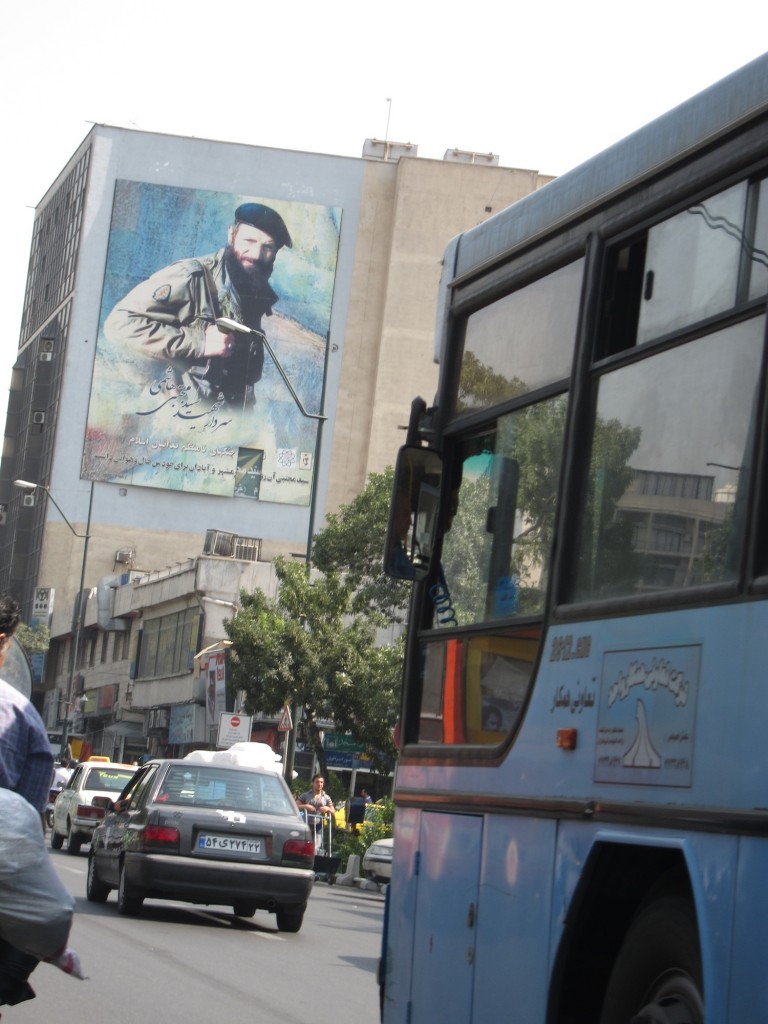
The village of Elika that I posted about a few days ago measures the magnitude of the trauma Iran suffered in the conflict. Elika lost 13 sons in the war, and losses of that scale are reflected throughout the country. Billboards celebrating the martyrs lost in the war loom over cityscapes and countrysides. The martyrs cemeteries near Khomeni’s shrine outside Tehran stretch for kilometers, reminiscent of the First World War cemeteries in France and Belgium.
Here’s Stephen Alvarez’s extraordinary image of photos of local martyrs hanging on a wall in the truck stop in Tellmadarreh, Iran. The seated man owns the truckstop. The men on either side of the Khamenei/Khomeni picture above the owner’s head are his uncles. Both died in the Iran-Iraq War. Here’s Stephen’s closeup of the photos.
One of my Persian friends speaks of a “lost soul” of an uncle, which her family thinks is a result of his wartime experiences.
Here’s Wikipedia’s detailed summary of the Iran/Iraq War.
And my photo of a poster of Ali and Hussein (crying the blood tear), the first two martyrs of Shia Islam, taken in the hilltop shrine of Emam Zadeh Ghasem above the village of Ali Mastam.

On a more current political note, The New York Review of Books (one of America’s great publications) just released this informative article by Haleh Esfandiari about “Iran’s Man in the Middle,” President-elect Hassan Rouhani.
Rope Diplomacy: On the Steeps in Iran.
The trip I took to Iran for the American Alpine Club exchange with the Alpine Club of Iran that I’ve been posting about recently wasn’t my first trip to Iran. I’d also been in 1999. On that trip, I climbed Mount Damavand with Tom Strickler and Abbas Jaffari and visited Yazd, Pasargad, Persepolis, Shiraz, Esfahan, Tehran, and the Caspian Sea, among other places. Here are four of my favorite black & white photos from that trip.


Another episode from the month I spent in Iran as a member of the American Alpine Club’s climbing exchange with the Alpine Club or Iran:

After our week at Alam Kuh, we returned to Tehran via a stop in a fruit market, where we gorged ourselves, and the village of Elika, a mountain village tucked into the twisted limestone canyons of the Central Alborz mountains below green-speckled slopes certain to brown with the advancing summer. A lead mine used to support the local economy, but it closed down many years ago. Nowadays, a few hundred people spend their summers in the area. Very few winter over in the village.

A stiff wind thrashed the poplar trees growing above the village’s decrepit wooden and adobe houses, now largely abandoned, and its more modern tin-roofed constructions. Inside the iron fence of one structure, an old man watered a garden. Nearby, a mongrel dog scratched its ear and flopped into a puddle of shade, utterly disinterested.
One of the Alpine Club of Iran members hosting our exchange was Mohammad Bahrevar, and when he was a boy, Mohammad spent his summers in the village. He was very proud of Elika, and took great delight in introducing it to us.

A superb climber, Mohammad learned to love high and wild places chasing up Elika’s local slopes. He was one of the very few city folks who could keep up with the mountain people.
Hossein Nouri, an old acquaintance of Mohammad’s father, invited us into his house for tea.

Us American climbers sprawled around the edges of Hossein’s plain, whitewashed front room. Exposed wooden beams lined the ceiling, and electric wires threaded between the beams and the roof. A small television stood in a corner. A space heater sat along another wall. A maroon curtain covered a storage alcove. In his late 50s or early 60s, with a small gray mustache, gray hair, and wearing a baseball hat, blue and white striped shirt, gray pants, and a vest for warmth, Hossein struggled to kneel with the rest of us on his worn Persian carpet. He shared tea and sweets and showed us a leather-bound prayer book more than 130 years old.


Just above the village, a small cemetery held the grave of Mohammad’s father.

The cemetery also contained the remains of Elika’s thirteen martyrs–the thirteen native sons the village lost during the Iran/Iraq War.
Iranian flags and the black flag of Imam Hossein, third Imam of Shia Islam, fluttered over their graves.


Rope Diplomacy: On the Steeps in Iran